For most of my life I believed getting better at something was an arithmetic problem. Want to write better? Write for longer. Want to speak better? Give more talks. Want to play the guitar sitting in the corner of the room? Put another hour into it. More hours in, more skill out.
Then I read about a fifteen year old clarinet player called Clarissa, and six minutes of her practice quietly dismantled the whole idea.
The six minutes that changed how I think about learning
Researchers were watching Clarissa develop as a musician. During one six minute stretch, her progress was described as greater than she had made in a far longer period of ordinary practice. What caught me was not the amount of progress. It was what those six minutes actually looked like.
She was not playing beautifully. She was struggling. She played a short section, made a mistake, and instead of carrying on she stopped. She stared at the music. She thought about what went wrong. Sometimes she hummed the phrase to herself. Then she tried again. Another mistake, another pause, another correction, another attempt.
From the outside it looked messy. Underneath the mess she was working right on the boundary between what she could already do and what she could not quite do yet. Daniel Coyle calls this deep practice, and once the idea landed I could not unsee it.
I had been treating mistakes like verdicts
I picked up a guitar at thirty four, largely because my daughter started lessons and I did not want to be the parent who only watched. For about a year I did the thing that feels like practice but is not. I played the songs I could already play. I sounded fine. I improved almost not at all.
The reason was simple, and slightly embarrassing once I saw it. Every time I fumbled the same chord change, some part of me read it as evidence. Maybe I am not naturally musical. Maybe I started too late. So I would skip past it and go back to the comfortable bit, which is a very efficient way of protecting your ego and a very poor way of learning anything.
A mistake is not a verdict on your ability. It is an address. It tells you exactly where to practise next. If you keep stumbling over the same transition, you have just found the precise location that deserves your attention. If you keep mispronouncing the same sound in a new language, you have been handed a specific, solvable job. If you always lose your thread at the same point in a presentation, that is not a personality flaw, it is a paragraph.
Good practice is not meant to feel good
This was the uncomfortable part. There is a zone where a task is hard enough to demand your whole attention but not so hard that you are lost. Coyle describes a rough twenty percent mistake rule as a way of thinking about that difficulty. It is not a scientific constant for every person and every skill. It is a useful dial.
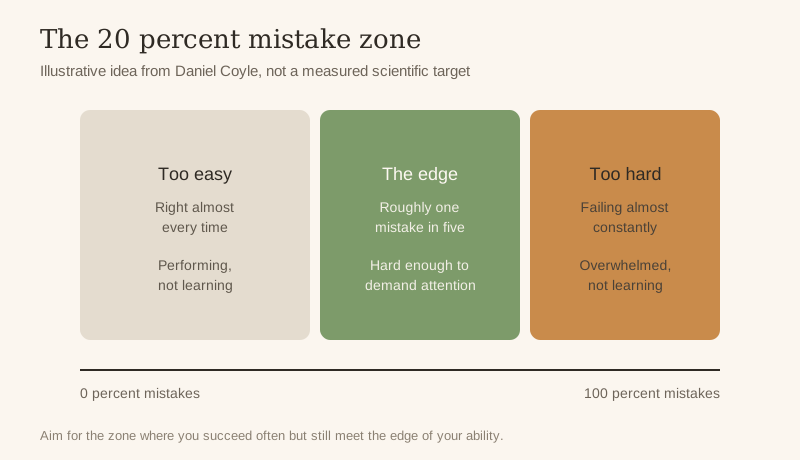
If you are getting it right virtually every time, the task is probably too easy and you are performing rather than learning. If you are failing almost constantly, the task is too hard and you are overwhelmed rather than learning. Somewhere in between is a zone where you succeed often but still bump into the edge of your ability often enough to find it.
This is also the honest answer to why so much practice feels pleasant and produces nothing. Pleasant practice is usually a recital of what you already own.
Why a child on a skateboard learns so quickly
Watch a kid learning a trick. They try it. The board tells them instantly whether it worked. They lose balance, shift their feet, try again, land differently, adjust again. Attempt, feedback, correction, attempt. The whole loop takes seconds.

Now picture a student sitting quietly through a lesson. Information is arriving, but they may not be doing anything with it. Fewer attempts. Fewer errors. Fewer corrections. Same hour, wildly different amount of learning.
So the question I ask now is not how long am I practising. It is how quickly am I moving from attempt to feedback to correction and back to another attempt. That, in practical terms, is learning velocity.
Shrink the skill until the hard part is unavoidable
The easiest way to speed up that loop is to stop practising the whole skill at once. At the Meadowmount School of Music, Coyle describes musicians cutting pieces into small sections and working each one separately. The principle travels a long way beyond music.
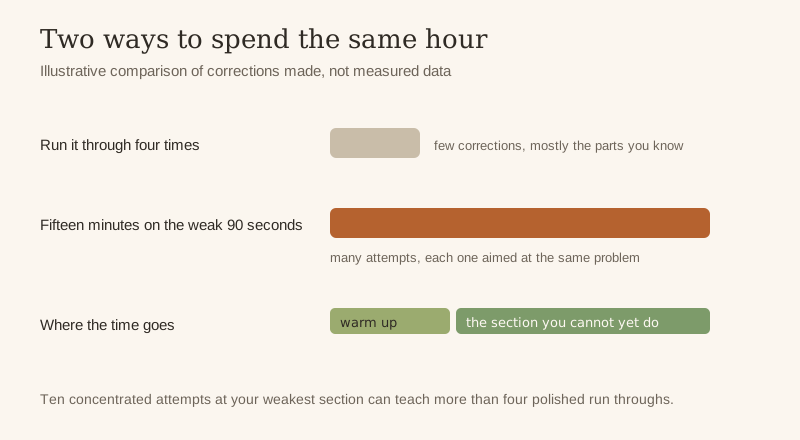
If you have a twenty minute presentation, you almost certainly do not need to deliver the whole thing ten times. The opening may already be strong. The real problem might be ninety seconds in the middle where the explanation goes soft. Practise those ninety seconds. Stop. Change one thing. Try again. Record it. Listen. Correct. Repeat.
Slow down before you speed up
At Spartak, a famously unglamorous Russian tennis club, young players were not thrown straight into matches. They rehearsed strokes slowly, sometimes without a ball, concentrating on movement, positioning and technique long before competition.
I used to equate improvement with speed. Now I deliberately slow things down, because speed hides mistakes and slowness exposes them. Play the phrase at half tempo and you can hear which finger is late. Say the sentence slowly and you can hear which word is doing no work. Once you can see the error, you can finally practise it.
Design the environment so the skill becomes unavoidable
Brazilian football gives the clearest example of this. For generations many players grew up on futsal, a compressed version of the game with fewer players in a much smaller space. Less room. Faster decisions. Smaller passing windows. Far more touches of the ball per hour.
Nobody has to tell a futsal player to concentrate. The game itself makes concentration compulsory. That gave me a question I now use constantly: can I redesign my practice so the thing I want to improve becomes unavoidable?
| Skill you want | Passive version | Environment that forces it |
|---|---|---|
| Conversational Spanish | Another textbook chapter | A conversation where you must reply in real time |
| Public speaking | Reading your notes aloud | Speaking with the notes face down, recorded |
| Clearer writing | Writing more words | A strict word limit that forces you to cut |
| Guitar chord changes | Playing songs you know | A metronome on the one change you keep missing |
| Coding | Watching tutorials | Building the thing with the tutorial closed |
Difficulty does not have to come from willpower. Often you can build it into the room.
Talent is less individual than I assumed
We love stories about exceptional people and we ask what made this person special. That question quietly hides the more useful ones. Who taught them? Who challenged them? Who did they watch every day? What behaviour did their surroundings reward? What examples showed them the thing was even possible?
Individual effort obviously matters, and physical characteristics matter in some activities. But talent does not grow in a vacuum. Many of the high performing environments Coyle visited were not luxurious at all. Some were shabby. What made them work was that mistakes happened constantly, feedback came fast, people could watch each other, fundamentals were taken seriously, and struggle was treated as normal rather than as proof that somebody lacked ability.
That changed what I think support means. Support is not always the removal of difficulty. Sometimes real support is a place where difficulty feels safe, where you can get it wrong out loud and try again without shrinking.
Stare, struggle and steal
Coyle describes strong learning environments as places where people can stare, struggle and steal. I find that genuinely freeing, because it removes the pressure to invent everything yourself.
Watch someone better than you. Study exactly what they do. Borrow the technique, copy the structure, then practise until it becomes yours. Children imitate language. Athletes imitate movement. Writers read writers. Designers study designers. Originality tends to arrive later, on top of a pile of borrowed technique.
Motivation often starts with seeing someone like you
I used to treat motivation as weather. Some mornings I had it, some mornings I did not. Coyle's idea of ignition offers a better explanation. Motivation frequently begins the moment you see a possible version of yourself: someone from your town, someone your age, someone with your background doing the thing you want to do.
There is a striking experiment where students read about a mathematician, and for some of them the mathematician's birthday was made to match their own. That tiny, meaningless connection led those students to persist considerably longer on a hard maths problem. The distance between people do that and people like me do that turns out to be enormous.
Pixar makes the same point in an organisational way. New arrivals were told plainly that they were now part of making movies, whatever their job title, and people across the company could watch unfinished work and offer notes. That produces belonging rather than mere incentive, and belonging is a remarkably durable fuel.
There is still no shortcut
This is where deep practice risks turning into another productivity hack, so let me be blunt. The lesson is not that six minutes is all you need. Clarissa's six minutes were powerful precisely because they were unusually concentrated, and she had put in plenty of ordinary hours around them.
Skill still needs repetition. Fundamentals still need time. Some abilities take years. The famous ten thousand hours figure is not a guarantee either, because repeating something for ten thousand hours does not automatically produce excellence. What matters is what happens inside those hours. Are you rehearsing what you already own, or reaching slightly past it?
How to learn faster: the method in five lines
- Choose a small piece of the skill. Not the presentation, the ninety seconds.
- Attempt it. At a difficulty where you get it wrong roughly one time in five.
- Notice the mistake precisely. Which note, which word, which finger, which second.
- Correct one thing. One change per attempt, so you know what caused the improvement.
- Attempt it again immediately. Shorten the gap between attempt and feedback as far as you can.
Then repeat, and stop when your attention goes. Fifteen honest minutes beats an hour of drifting. I now open a practice session by naming the single thing I cannot do yet, and I close it by writing down where I struggled. That note is next session's starting point.
Small improvements have a way of becoming big ones
You do not need to be dramatically better today. You need to move the edge of your ability a little, and then move it again tomorrow. The one percent a day idea is often quoted with more mathematical confidence than real skill deserves, since some days you leap, some days you plateau and some days you seem to go backwards. The underlying point survives anyway. Small improvements accumulate, and once you stop demanding breakthroughs, ordinary sessions start to feel worth showing up for.
Two years on, I can play the songs my daughter learns, badly at first and then not badly. What changed was not the number of hours. It was that I finally started spending them on the bars I could not play.
The question I ask myself now
I no longer end a session by asking how long I practised. I ask where I struggled, because that struggle holds the most useful information in the whole session. The difficult paragraph. The missed note. The awkward sentence. The question I could not answer. That is the edge, and rather than avoiding it I can go back, slow it down, break it apart, watch someone who does it better, and try again.
There may be no magic six minute route to mastery. But there can absolutely be six minutes containing more attention, more feedback and more useful struggle than you would normally fit into an hour. Once I understood that, getting better stopped feeling mysterious. Talent stopped looking like something I was waiting to find in myself, and started looking like something I could build on purpose.
Frequently asked questions
What is deep practice?
Deep practice is working at the edge of your current ability, making mistakes on purpose, stopping to identify each one and correcting it before trying again. It is the opposite of smooth repetition of what you can already do.
How is deep practice different from deliberate practice?
They describe the same family of ideas from different angles. Deliberate practice, from the research tradition of Anders Ericsson, emphasises specific goals, focused effort and expert feedback. Deep practice, Daniel Coyle's term, emphasises the felt experience of struggling at the edge and correcting errors quickly.
How long should a practice session be?
Shorter than you think, and only as long as your attention holds. Fifteen to thirty focused minutes aimed at one weak section will usually beat an hour of drifting through the whole skill.
Does the ten thousand hour rule work?
Not as a formula. Hours matter, but the quality of what happens inside them matters more. Ten thousand hours of repeating what you already do well will not produce mastery.
How do I know if a task is at the right difficulty?
Use the rough twenty percent guide. If you almost never fail, make it harder. If you almost always fail, make it smaller or slower until you can succeed most of the time while still meeting real resistance.
Sources and further reading
- Daniel Coyle, The Talent Code (Bantam, 2009), on deep practice, ignition and master coaching.
- Daniel Coyle, The Little Book of Talent (Bantam, 2012), for the stare, struggle and steal framing and the practice rules.
- K. Anders Ericsson, Ralf Krampe and Clemens Tesch-Romer, "The Role of Deliberate Practice in the Acquisition of Expert Performance", Psychological Review, 1993.
- Gary McPherson and James Renwick's longitudinal research on young musicians' practice behaviour, the studies behind the Clarissa account.
- Gregory Walton and Geoffrey Cohen, "A Question of Belonging", Journal of Personality and Social Psychology, 2007, on shared identity cues and persistence.