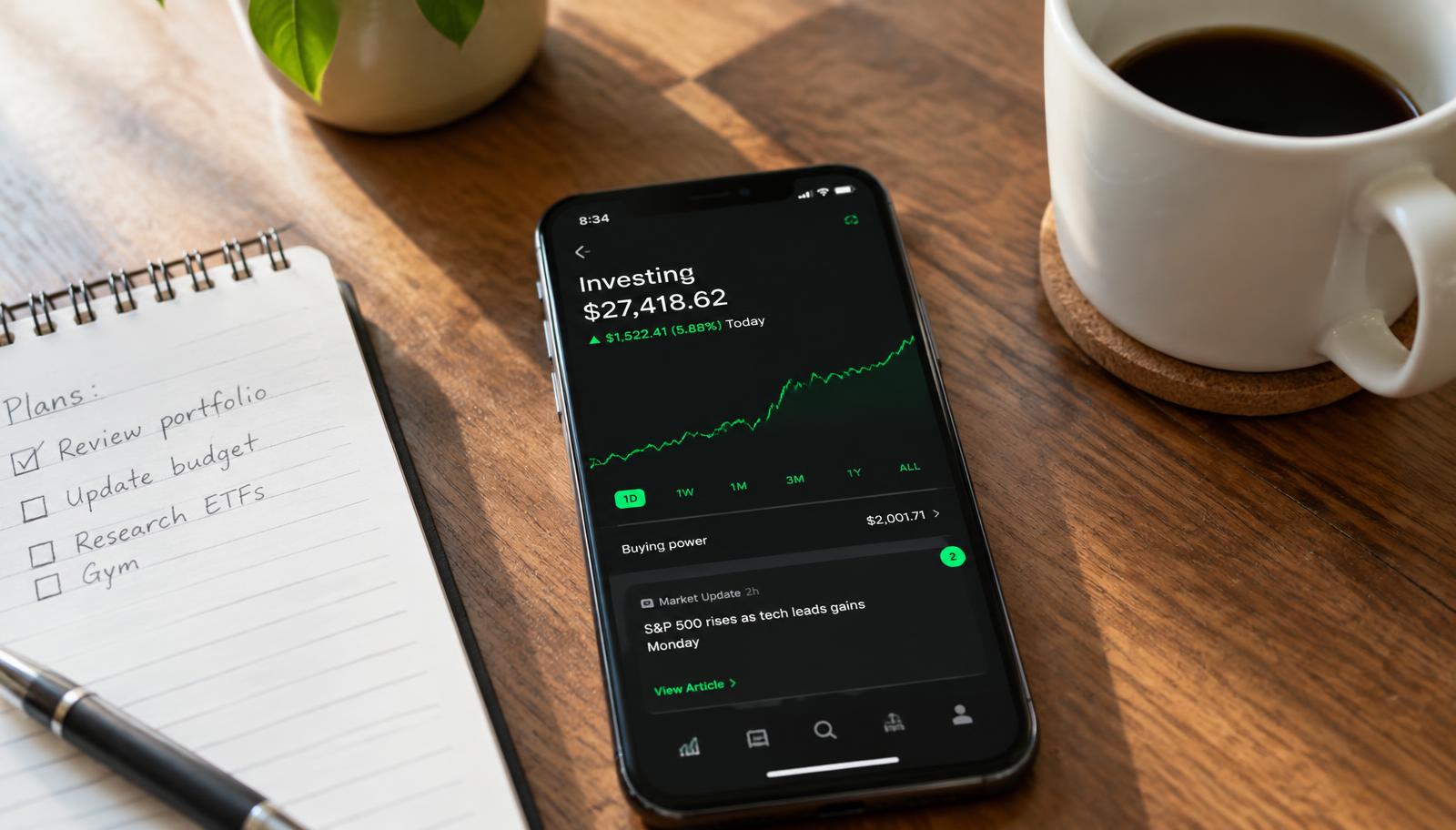
In 2014 I kept a spreadsheet of every trade I made. At the end of the year I compared my results against a boring global index fund I had been ignoring. I had made 34 individual trades, spent probably 90 hours on research, paid a small fortune in spreads and commissions, and I had underperformed the index fund by 4.2 percentage points.
I did not stop picking stocks. I did something better. I moved the majority of my money into index funds and kept a smaller, deliberately limited slice for the individual names I genuinely wanted to research. Twelve years later, the boring part of the portfolio has done most of the work.
Start with the only variable you control
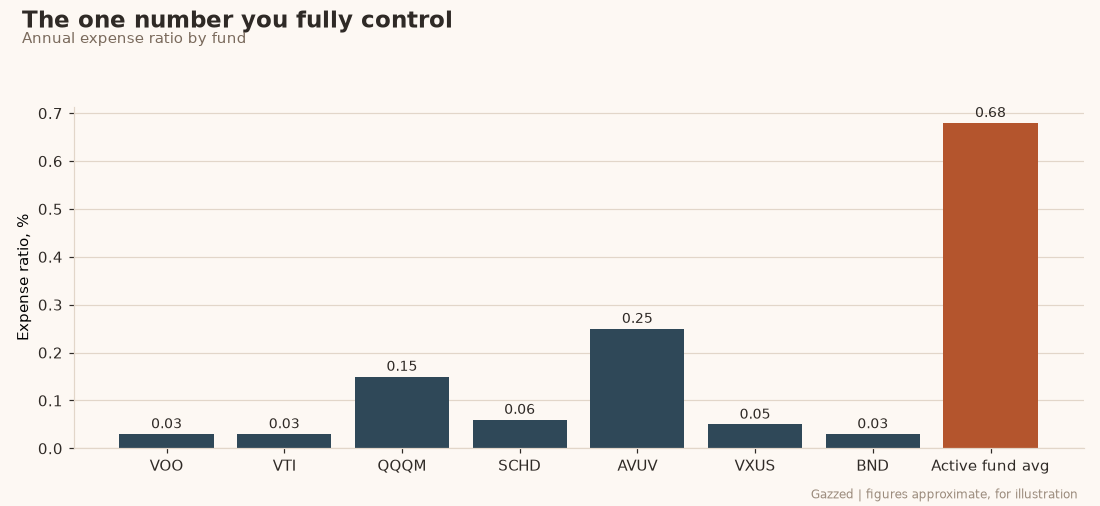
You cannot control returns. You can control fees, and over thirty years the difference between a 0.03 percent fund and a 1 percent fund on the same underlying index is not a rounding error, it is a meaningful share of your final balance. The maths is unforgiving and it compounds in the wrong direction the whole time.
Expense ratio is not the whole story though. Tracking difference, which is how far the fund actually lags its index after everything including securities lending income, is the number professionals watch. A fund with a 0.07 percent fee and good lending revenue can beat a 0.03 percent fund in practice. Check the fund factsheet for three year tracking difference rather than trusting the headline fee alone.
The five ticker portfolio
| Ticker | Exposure | Expense ratio | Holdings | Role | Suggested weight |
|---|---|---|---|---|---|
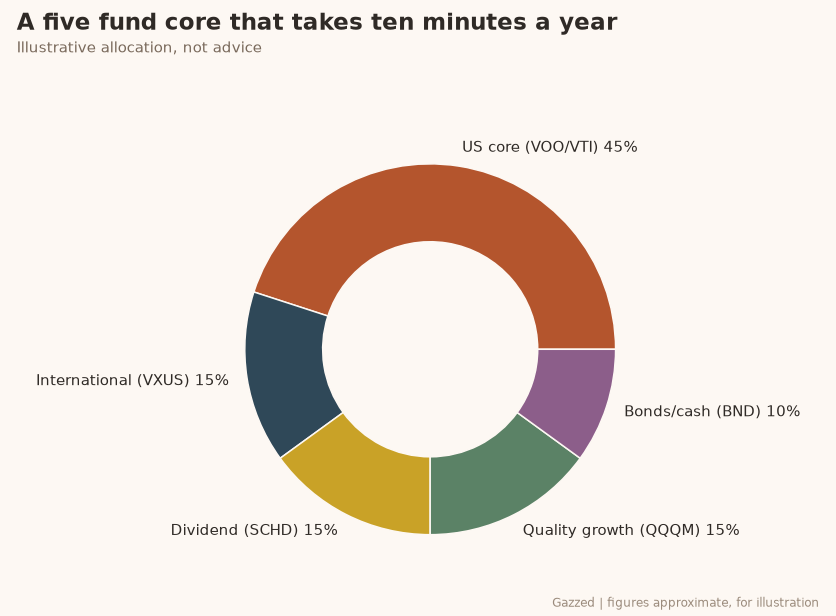
| VOO | S&P 500 | 0.03% | 503 | Core US growth engine | 40% |
| VXUS | Global ex US | 0.05% | 8,500+ | Diversification and valuation | 20% |
| AVUV | US small cap value | 0.25% | 700+ | Return premium tilt | 10% |
| SCHD | US quality dividend | 0.06% | 100 | Income and defensiveness | 15% |
| BND | US aggregate bonds | 0.03% | 11,000+ | Volatility ballast | 15% |
VOO: the core
The S&P 500 at three basis points. There is nothing clever to say about it, which is the point. One thing worth knowing: the index is now heavily concentrated, with the largest ten holdings representing roughly a third of the fund. That is not a flaw, it reflects reality, but it does mean your supposedly diversified core has a meaningful technology tilt. If you also hold the individual names from the AI stocks article, your true exposure is higher than you think.
VXUS: the part everyone skips
International equities underperformed the US for more than a decade, so most investors abandoned them. That is precisely the behaviour that creates the valuation gap now sitting at roughly 14 times forward earnings abroad versus 22 in the US. I hold it because I do not know which decade belongs to whom, and neither does anyone else.
AVUV: the evidence based tilt
Small cap value has historically delivered a premium over the broad market across multiple countries and long time periods. It also goes through brutal stretches of underperformance lasting years. Only hold this if you can sit through that without changing your mind, otherwise it will cost you money through bad timing. At 0.25 percent it is the most expensive fund here, and the active screening is what you are paying for.
SCHD: quality dividends
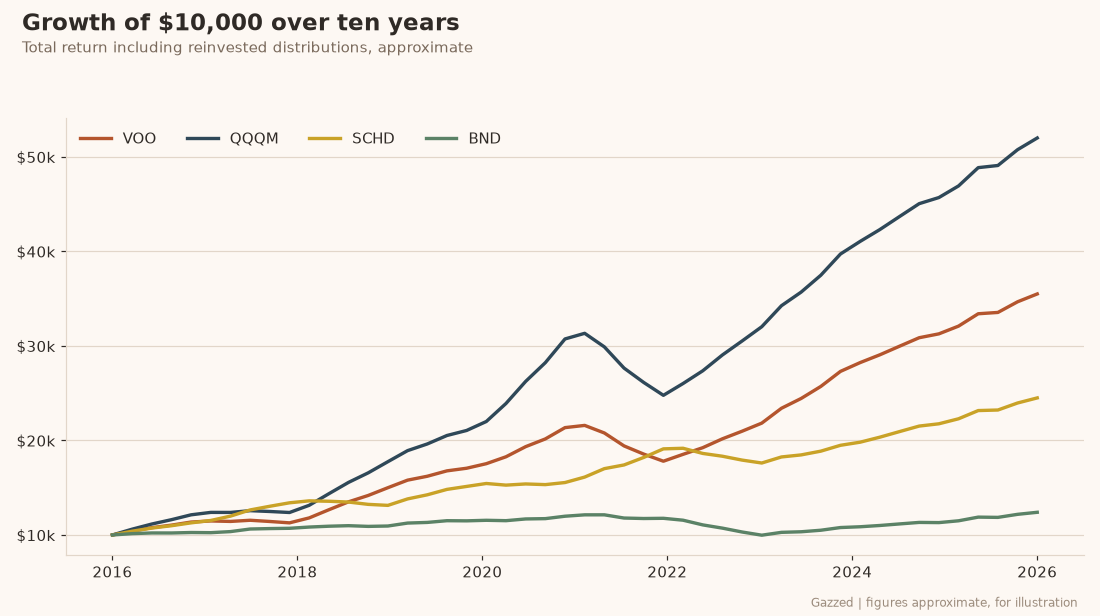
The screen requires ten years of dividend payments plus filters on cash flow to debt, return on equity, dividend yield and growth. The result is a hundred profitable, cash generative businesses at a fee of six basis points. It tends to fall less in drawdowns and lag in speculative rallies. In 2022 that was worth a great deal.
BND: the boring stabiliser
Bonds had a genuinely terrible 2022 and many investors concluded they were broken. What actually happened is that yields reset from near zero to a level where bonds do their job again. The starting yield is the single best predictor of a bond fund next decade return, and that starting point is now far more attractive than it was in 2021.
Check your overlap before you buy
The most common portfolio mistake I see is owning four funds that are really one fund. An S and P 500 tracker, a total market fund, a Nasdaq fund and a large cap growth fund are not diversification, they are the same twenty companies at four different weights, and you are paying four fees for the privilege.
Before adding any fund, pull the top ten holdings of everything you already own and add up the duplicates. If a new fund shares more than roughly 60 percent of its weight with an existing holding, it is not adding diversification. That one check would prevent most of the messy portfolios people send me.
If you are investing from the UK
- US domiciled ETFs are generally not available through UK brokers to retail investors because of disclosure rules. Use UCITS equivalents such as VUAG, VWRP or VHVG.
- Prefer Irish domiciled funds for US equity exposure. The tax treaty reduces withholding tax on US dividends from 30 percent to 15 percent, which is worth roughly 0.2 percent a year on a US equity fund.
- Accumulating share classes reinvest dividends inside the fund, which is simpler inside an ISA and avoids constant small cash balances.
- Use the ISA and pension allowances first. A tax wrapper is worth more than any amount of fund selection cleverness.
Rebalancing without overthinking it
Pick one date a year. Compare each holding against its target weight. If anything has drifted more than five percentage points, sell the excess and top up the laggard. Inside a tax wrapper that is free. In a taxable account, rebalance with new contributions instead of selling, which avoids triggering a tax event.
That is the entire maintenance burden. Twenty minutes, once a year. Anything more elaborate has a poor record of adding value and a good record of adding costs.
What actually goes wrong
Studies of investor behaviour consistently find that the average fund holder earns less than the average fund, because of buying after strong periods and selling after weak ones. The gap is typically between one and two percentage points a year. Every structural decision in this article, from automatic contributions to mechanical rebalancing to holding bonds you may not feel you need, exists to close that behaviour gap. The funds are the easy part. Not touching them is the skill.
Tax treatment changes the answer more than fund selection does
Two investors can hold identical funds and end up with materially different outcomes purely because of account structure. Growth assets with high expected returns belong in the most tax advantaged account you have, because that is where sheltering compounding is worth the most. Bonds and high yield funds, which throw off income taxed at ordinary rates in many jurisdictions, are usually better placed inside a tax deferred or tax free wrapper than in a plain brokerage account.
In the United States that means filling the 401k and IRA space first, then using a taxable account for broad index funds that are naturally tax efficient because they turn over very little. In the UK it means using the ISA allowance every year without fail, then the pension for anything you genuinely will not touch before retirement age. The pension carries the better tax relief and the worse access. Both are better than an unwrapped account.
One detail that trips people up repeatedly: reporting status for offshore funds. A UK investor holding a fund without reporting status can find gains taxed as income rather than capital gains, which is a materially worse outcome. Every mainstream UCITS ETF on a large platform has reporting status, but it is worth a thirty second check before buying anything obscure.
The mechanics people get wrong when buying
- Use limit orders. Market orders on a thinly traded fund, especially near the open or close, can fill several tenths of a percent away from fair value. A limit order at or near the mid price costs nothing and prevents that.
- Avoid the first and last fifteen minutes of the session. Spreads are widest then because the underlying holdings are not all pricing cleanly.
- Check the premium or discount to net asset value for anything holding international or less liquid assets. A persistent premium means you are paying more than the holdings are worth.
- Automate contributions. A standing monthly purchase removes the single largest source of underperformance, which is you deciding whether this month feels like a good time.
On fund size and closure risk, my rule is to avoid anything with less than roughly 200 million dollars of assets unless there is a very specific reason. Small funds get closed, and a closure forces a sale at a moment you did not choose, potentially creating a tax bill you did not plan for. It is a rare event, but it is entirely avoidable.
Frequently asked questions
How many ETFs should I own?
Between one and five. One global fund is a genuinely complete portfolio. Beyond five you are almost certainly duplicating exposure.
Is VOO or VTI better?
They have tracked each other closely for decades because the small and mid cap portion of VTI is a small share of its weight. Pick either and stop thinking about it.
Should I invest a lump sum or spread it out?
Historically lump sum wins roughly two thirds of the time because markets rise more often than they fall. Spreading it out reduces regret risk, which for many people is the more important factor.
Education only, not financial advice or a recommendation of any specific fund. Fees and holdings change, so check current documents before investing.