I bought my first four shares of Nvidia in October 2019 for a little under eleven dollars a share on a split adjusted basis. It was not a genius call. I was building a gaming PC with my brother, the card we wanted was out of stock everywhere, and I made a throwaway joke that we should just buy the company instead. Two weeks later I put 47 pounds into the stock because that was what I had left after the graphics card. I forgot about it for three years. When I finally looked again in 2023, the position had done something to my brain that no spreadsheet ever had.
That story is the reason I write about AI stocks the way I do. Luck got me in. Only fundamentals will decide whether I stay. So this is not a hype list. It is seven companies I actually track quarter by quarter, with the numbers I use, the pipeline I am watching, and the price ranges where I would add, hold or trim.

Why 2026 is a different market to 2023
The first phase of this cycle was simple. One company sold the shovels, everybody bought them, and the stock chart looked like a wall. The second phase, the one we are in now, is messier and more interesting. Training clusters are being joined by inference fleets. Custom silicon from Broadcom and Marvell is taking real share of accelerator spend. Power, not chips, is becoming the binding constraint. And investors have started asking the question that actually matters: who earns a return on all this capital?
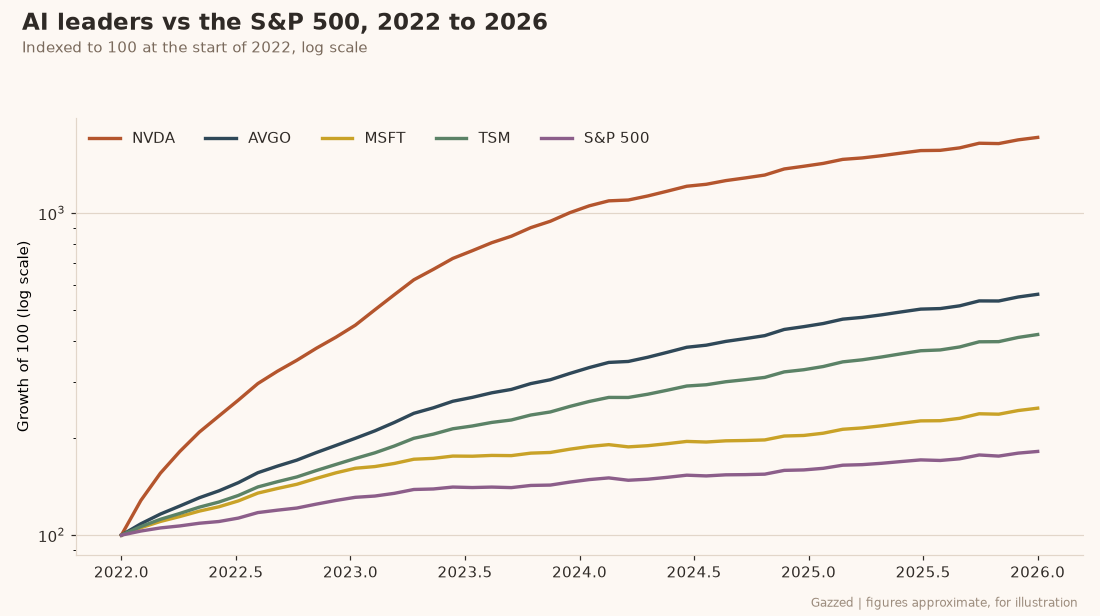
The chart above is the single most useful thing I show people who ask if they have missed it. On a log scale you can see the slope of Nvidia gains flattening while Broadcom and TSMC keep grinding upward. That is what broadening looks like. It is also a warning: the easy multiple expansion is behind us, and from here returns have to come from earnings.
The demand curve in one chart: hyperscaler capex
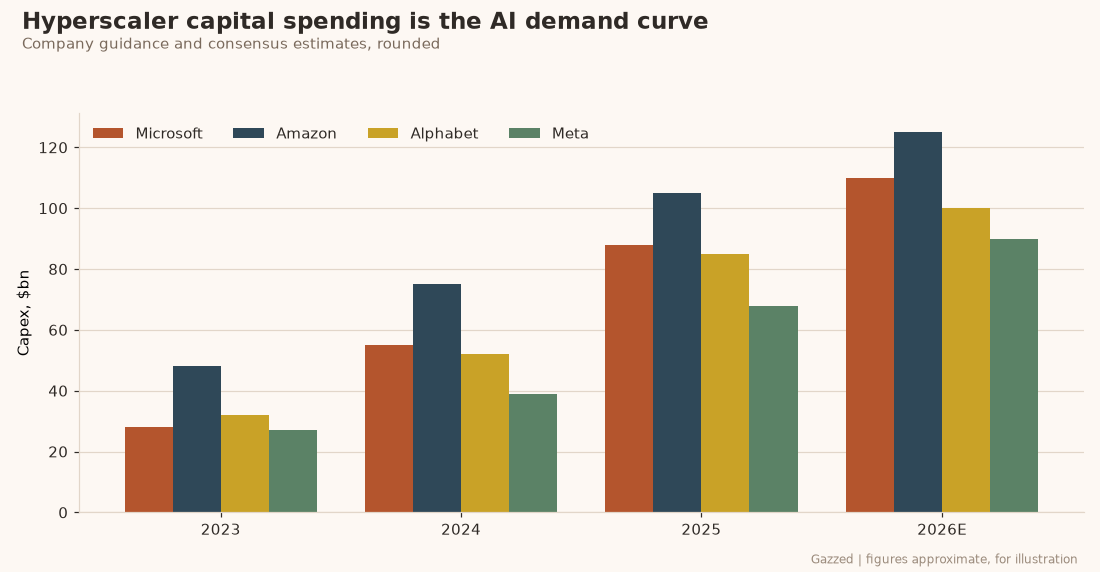
Every thesis in this article rests on that bar chart. Combined capex from Microsoft, Amazon, Alphabet and Meta has gone from roughly 135 billion dollars in 2023 to an estimated 425 billion in 2026. Four customers, one spending decision each. That concentration is the sector great strength and its single biggest risk, and any investor who ignores it is not investing, they are hoping.
My rule is simple. I read the capex guidance line in each hyperscaler quarterly release before I read anything about the chip companies. If two of the four guide capex down in the same quarter, I reduce exposure regardless of how good the semiconductor earnings look, because chip revenue lags spending intent by two to three quarters.
The seven AI stocks, with numbers
| Ticker | Role in the stack | Fwd P/E | Est. rev growth | Gross margin | My range |
|---|---|---|---|---|---|
| NVDA | Accelerators, networking, CUDA software | 32x | 38% | 73% | Add under 150, trim over 260 |
| AVGO | Custom ASICs plus networking silicon | 34x | 26% | 77% | Add under 250, trim over 430 |
| TSM | Leading edge foundry and advanced packaging | 22x | 24% | 59% | Add under 210, trim over 340 |
| MSFT | Cloud, model access, enterprise distribution | 29x | 15% | 69% | Add under 400, trim over 620 |
| GOOGL | Own silicon, own models, own demand | 23x | 14% | 58% | Add under 200, trim over 330 |
| AMD | Second source accelerators, server CPUs | 38x | 30% | 54% | Add under 120, trim over 220 |
| VRT | Power and liquid cooling for AI halls | 30x | 22% | 36% | Add under 95, trim over 180 |
1. Nvidia (NVDA): still the toll booth
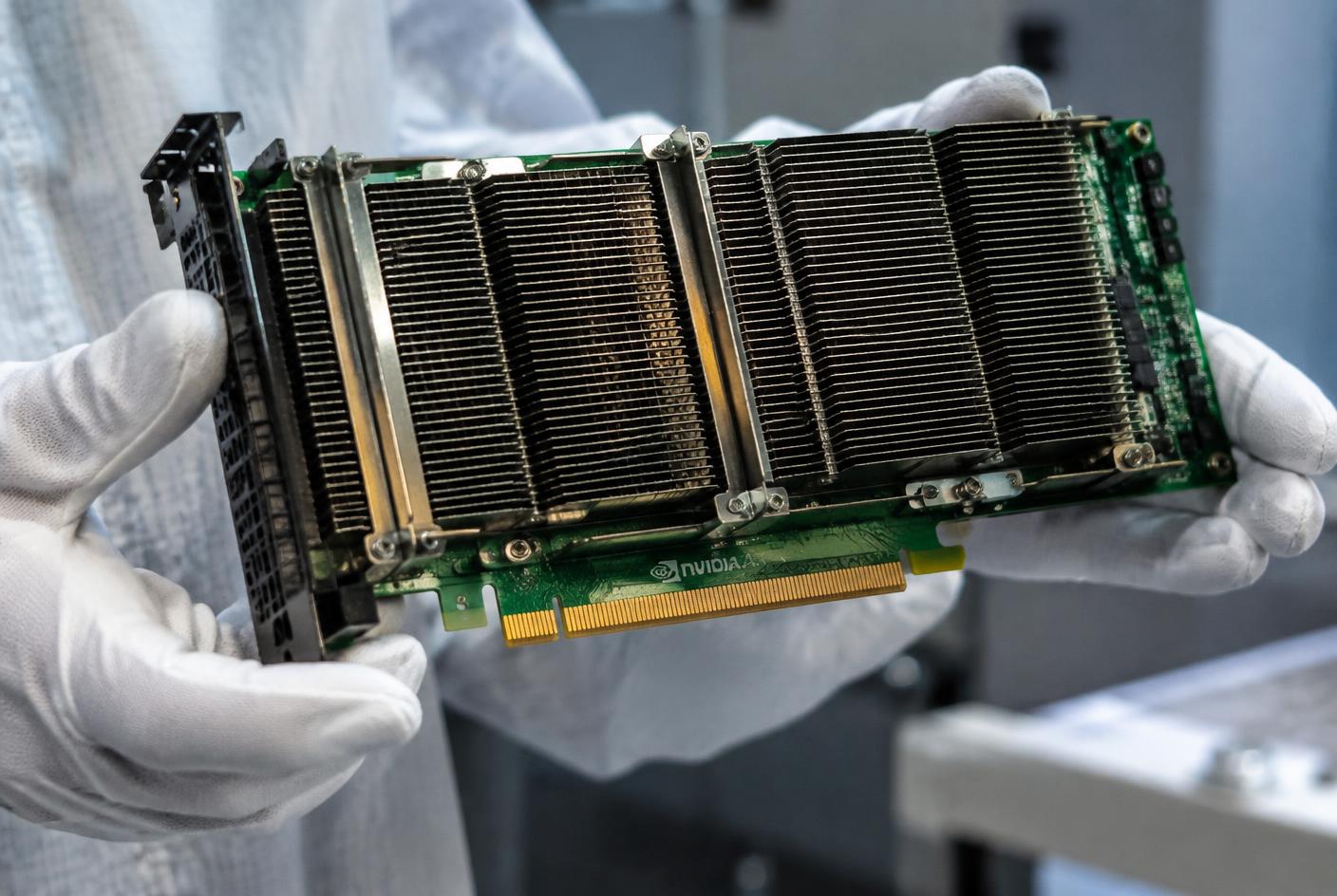
The bear case I hear most often is that gross margin in the mid seventies cannot last. Probably true. The bull case that actually holds up is different: Nvidia sells rack scale systems now, not chips, and networking plus software attach makes the average selling price per rack sticky even when per chip pricing softens. Watch three lines in every release. Data centre revenue split between compute and networking, inventory and purchase commitments, and the customer concentration note in the filings.
Pipeline matters here more than any valuation model. The annual cadence of new architectures with roughly two and a half times performance per watt uplift is what keeps hyperscalers upgrading rather than sweating older fleets. If that cadence slips to eighteen months, the multiple compresses fast.
2. Broadcom (AVGO): the quiet second winner
Broadcom is the stock I have added to most in the last two years. Custom accelerators designed with a handful of very large customers carry lower gross margin than merchant GPUs but far better visibility, because they are locked into multi year programmes. Add the networking franchise, where AI back end switching is an underrated growth line, and the software business that nobody talks about, and you get free cash flow conversion above 40 percent of revenue. That is the number I care about.
3. TSMC (TSM): everything goes through one building
Every chip on this page is made by the same company. TSMC trades at a discount to its customers, at roughly 22 times forward earnings, entirely because of geopolitics. Advanced packaging capacity is the real bottleneck and it is sold out well into the future. If you want AI exposure with less product risk, this is the cleanest way to own the whole sector at once, provided you can live with the headline risk.
4. Microsoft (MSFT): the monetisation test
Microsoft is where the AI story either becomes a profit and loss line or stays a capex line. The metrics to track are Azure growth attributable to AI services, the seat count and attach rate for Copilot, and operating margin, which has been squeezed by depreciation on all that new infrastructure. I hold it as the sensible core position, not the exciting one.
5. Alphabet (GOOGL): vertically integrated and cheap
Alphabet designs its own accelerators, trains its own frontier models, and owns the distribution to put them in front of billions of people. It is also the cheapest large cap on this list. The risk is obvious and real: search economics under pressure from chat interfaces, plus regulation. The offset is that cloud has finally become a meaningful profit contributor.
6. AMD: the second source trade
Nobody wants a single supplier. That sentence alone is the AMD thesis. Every point of accelerator market share is worth several billion dollars of revenue, and the server CPU business quietly keeps taking share too. This is the highest variance name on the list. Position size accordingly, which for me means half what I hold in Broadcom.
7. Vertiv (VRT): the picks and shovels of the picks and shovels
Racks need power distribution and liquid cooling. Vertiv sells both, with a backlog that reads like a forward order book for the whole AI build out. Lower margin, more cyclical, genuinely tied to the same demand curve. I treat it as a satellite position and I watch book to bill above 1.2 as the health signal.
How I actually set a price target
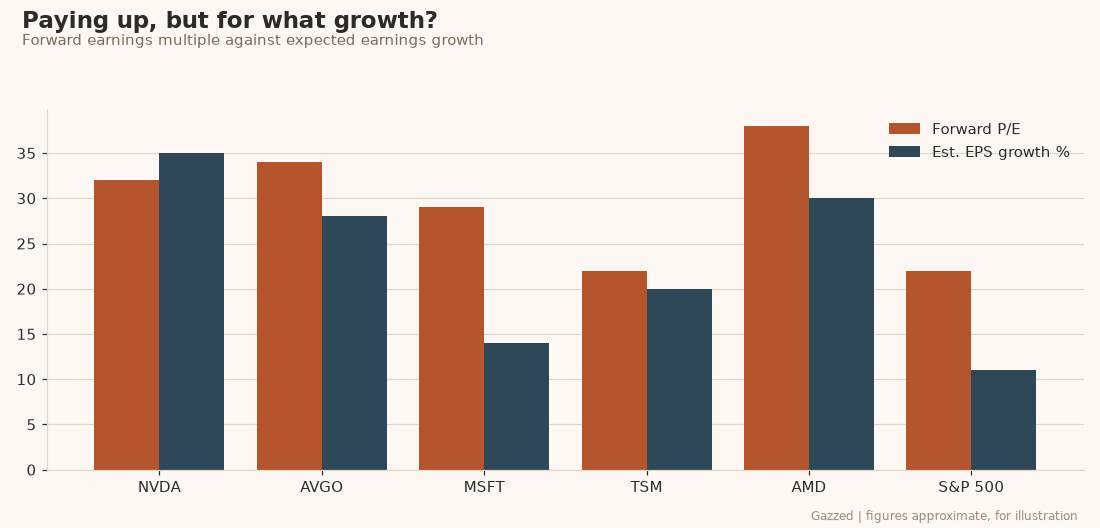
My method is deliberately boring. I take a conservative estimate of earnings per share two years out, apply a multiple no higher than the company five year median, and then discount the result back at ten percent a year. If the answer is not at least 30 percent above the current price, I do not buy, I wait. For Nvidia that maths currently produces a fair value band rather than a single number, roughly 185 to 240 dollars depending on whether you assume gross margin of 70 or 75 percent. Anyone quoting a precise target to the cent is selling certainty that does not exist.
The four risks I write on the front page of my notebook
- Customer concentration. Four buyers control the demand curve. One capex pause resets sentiment across the sector.
- Depreciation catching up. Infrastructure bought in 2024 starts hitting income statements hard. Watch free cash flow, not headline earnings.
- Power constraints. Grid connections, transformers and turbines are now the gating item. That is also why I own energy names, covered in a separate piece.
- Financing structures. More of this build out is being funded with debt and vendor arrangements than in 2023. It is not 1999, but it rhymes a little more than it used to.
How I hold these in a real portfolio
Total AI exposure sits at about 18 percent of my equity book, and I force myself to rebalance when any single position goes above 7 percent. I learned that discipline the expensive way in 2021, when I let a position run to 22 percent and then watched it halve while I told myself a story about conviction. Conviction is not a risk management framework. A written rule is.
If picking seven names sounds like work you do not want, the honest answer is that a broad index fund already gives you meaningful exposure to most of this list. I explain how that works in the ETF guide, and if you want the other side of the trade, read the energy piece, because the electricity these chips consume has to come from somewhere.
Frequently asked questions
Is it too late to buy AI stocks in 2026?
Too late for the 2023 style repricing, yes. Not too late for earnings growth. The sector now needs to grow into its multiple rather than expand it, which historically produces decent but far less spectacular returns.
Which AI stock is safest?
Alphabet and Microsoft carry the least single product risk because AI is one line in a very large, cash generative business. Safest never means risk free.
Should I buy an AI ETF instead?
If you cannot name the top five holdings of the fund and explain why each is there, then yes, a broad low cost ETF is the better choice.
This article is for information and education. It is not financial advice, I am not your adviser, and I hold positions in several of the companies mentioned. Do your own research before investing.