On 9 March 2009 I sold everything. The bottom, as it turned out, was that exact week. I locked in a loss of around 14,000 pounds, which at the time represented about four years of saving, and then I sat in cash for eleven months while the market rose 60 percent without me. I have never made a more expensive decision and I never will, because the entire structure of how I invest now exists to stop me repeating it.
Defensive funds are not about maximising returns. They are about making sure the version of you who panics never gets the chance to sell at the bottom. Judged that way, a fund that underperforms in good years and holds its value in bad ones is doing exactly what you paid it for.

What makes an ETF genuinely defensive
Three measurable things, all of which you can check on a fund factsheet in about two minutes.
- Beta below 0.8. The fund moves less than the market in both directions.
- Maximum drawdown meaningfully smaller than the index in at least two separate stress events, ideally 2020 and 2022, since those had completely different causes.
- Holdings with inelastic demand. Look at the top twenty positions. If they are cyclical industrials with a low volatility label attached, it is a marketing exercise.
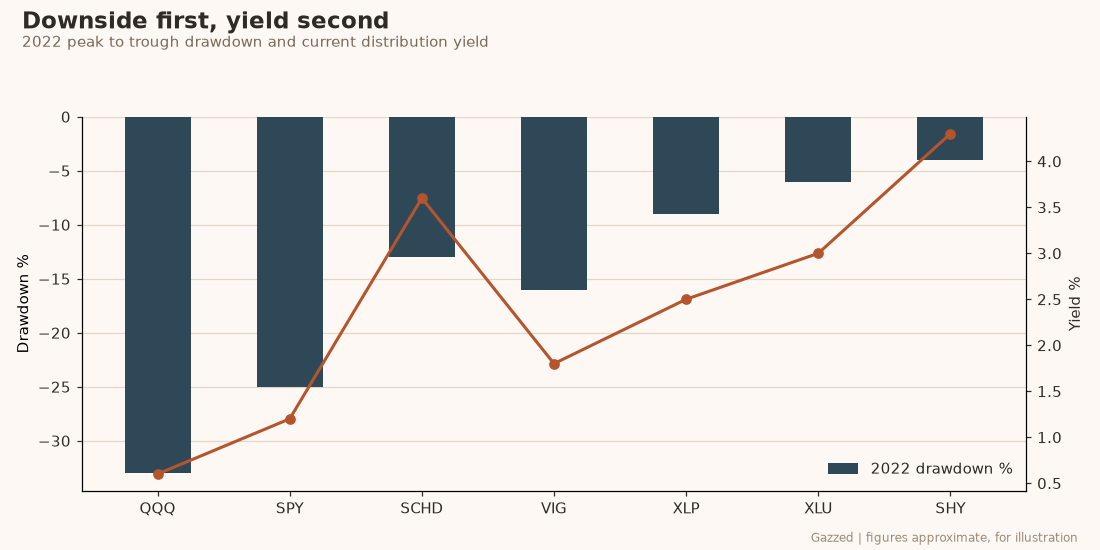
The nine funds
| Ticker | What it holds | Fee | Yield | Beta | 2022 return |
|---|---|---|---|---|---|
| SCHD | 100 quality US dividend payers | 0.06% | 3.6% | 0.78 | -3.2% |
| XLP | S&P 500 consumer staples | 0.09% | 2.6% | 0.58 | -0.6% |
| XLU | S&P 500 utilities | 0.09% | 3.0% | 0.55 | +1.6% |
| USMV | US minimum volatility | 0.15% | 1.9% | 0.70 | -9.4% |
| VIG | Dividend growth, 10 year streaks | 0.05% | 1.8% | 0.85 | -9.8% |
| VHT | US healthcare | 0.09% | 1.5% | 0.72 | -5.9% |
| BND | US aggregate bonds | 0.03% | 4.2% | n/a | -13.1% |
| SGOV | Zero to three month Treasury bills | 0.09% | 4.3% | 0.00 | +1.5% |
| GLDM | Physical gold | 0.10% | 0% | 0.10 | -0.8% |
Why 2022 is the most useful column in that table
2020 was a fast crash with an even faster recovery, so almost nothing had time to prove itself. 2022 was a slow grind driven by interest rates, and it broke the classic sixty forty portfolio because bonds and shares fell together. Any fund that held up in 2022 did so for structural reasons rather than luck. Note that BND has the worst number in the table. That is not a reason to avoid bonds, it is a reason to understand duration, which is what caused it.
Notes on the individual funds
SCHD is the one I hold in the largest size. The screen demands ten years of dividends plus quality filters on cash flow to debt and return on equity, which quietly excludes most of the fragile high yielders that blow up in downturns. The trade off is that it owns almost no technology, so it will feel painful during any AI led rally.
XLP and XLU are the purest sector expressions of defensiveness. Staples sell things people buy regardless of income. Utilities are regulated monopolies earning a set return on their asset base, and as covered in the energy article, that asset base is growing again for the first time in two decades. Utilities do carry real interest rate sensitivity, so they are defensive against recession rather than against rising rates.
USMV selects for low volatility with sector constraints so it does not become a pure utilities bet. It has done its job in most drawdowns. It is also the fund most likely to disappoint in a sharp inflation shock, because low volatility screens tend to favour bond like equities.
SGOV is the underrated one. Ultra short Treasury bills, effectively no interest rate risk, a yield that tracks the policy rate, and daily liquidity. It is where your dry powder should sit rather than in a current account. When markets fall, this is the position you sell to buy the things that are cheap.
GLDM produces no income and has no earnings, which makes it impossible to value in any conventional sense. I hold a small slice anyway because its correlation to equities during crises is close to zero and it has historically performed well in exactly the scenarios that hurt everything else, namely currency debasement and geopolitical shocks.
A worked all weather allocation
| Sleeve | Fund | Weight | Job |
|---|---|---|---|
| Growth | VOO or a global tracker | 40% | Long term compounding |
| Quality income | SCHD | 20% | Cushion plus rising income |
| Bonds | BND | 20% | Ballast, income, deflation hedge |
| Cash equivalent | SGOV | 10% | Dry powder and spending buffer |
| Real asset | GLDM | 10% | Crisis and inflation hedge |
This portfolio will never top a performance table. In a strong bull market it will lag a pure equity fund by several percentage points a year and you will feel foolish. Its purpose is to produce a drawdown shallow enough that you never reach the emotional point I reached in March 2009. Measured against that objective, it works.
Defensive mistakes that are worse than doing nothing
- Inverse and leveraged funds. They reset daily and decay over time. They are trading instruments, not protection, and holding them for months is a reliable way to lose money even when your market call is correct.
- Buying protection after the fall. Defensive assets are most expensive precisely when everybody wants them. The allocation has to exist before you need it.
- Treating gold as a core holding. Long stretches of nothing followed by sudden moves. Small slice, no expectations.
- Owning six defensive funds that hold the same twenty companies. Check the overlap. XLP, VIG and SCHD share a lot of ground.
When to actually change the allocation
Not when a headline scares you. The only reasons I change mine are a change in my time horizon, a change in income stability, or a drift beyond five percentage points from the targets. Every attempt I have made to adjust based on a macro forecast has cost me money, including the ones where the forecast turned out to be right, because getting back in is a second decision you also have to get right.
For the individual company versions of this same idea, see the recession proof stocks piece, and for the growth side of the portfolio the core ETF guide covers what sits in that 40 percent sleeve.
Understanding duration, the thing that broke bonds in 2022
Duration measures how sensitive a bond fund price is to a change in interest rates. A fund with a duration of six years falls roughly six percent for every one percentage point rise in yields, and rises by a similar amount when yields fall. In 2022 yields rose faster than at almost any point in modern history, which is precisely why a supposedly safe aggregate bond fund lost double digits.
The important point is that this was a price effect, not a credit event. Nothing defaulted. The bonds inside the fund still matured at par, and the fund income rose substantially as older low yielding bonds were replaced with new higher yielding ones. An investor who held on now earns a materially better yield than they did in 2021. An investor who sold in late 2022 locked in the loss and missed the income recovery, which is the same mistake I made with equities in 2009 wearing different clothes.
If rate sensitivity worries you, shorten duration rather than abandoning bonds. Short term Treasury funds have duration under two years and barely move on rate changes. You give up some return in a falling rate environment in exchange for a much smoother ride.
Turning a defensive portfolio into income
For anyone drawing on their portfolio rather than building it, the defensive sleeve does a second job. The traditional approach is to sell a fixed percentage each year, but that forces sales during downturns, which is exactly the behaviour that damages long term outcomes. A better structure is to hold two to three years of planned withdrawals in short dated bills and quality dividend funds, and only refill that bucket from the growth sleeve after strong years.
Run the numbers on the allocation table above and the blended yield comes out around three percent before any capital growth. On a portfolio of 500,000 dollars that is roughly 15,000 dollars a year of natural income without selling a single share. That figure will not fund a retirement on its own for most people, but it dramatically reduces how much you need to sell in any given year, and reducing forced selling is the entire objective.
The uncomfortable truth is that the optimal portfolio on a spreadsheet and the optimal portfolio for a real human are rarely the same document. Mine holds more in cash equivalents than any model would recommend, because I know exactly what I am like when the screen turns red, and I have the 2009 receipt to prove it.
Frequently asked questions
What is the safest ETF to own in a recession?
Short dated Treasury bill funds such as SGOV carry the least price risk. Safety there comes at the cost of almost no long term growth.
Are dividend ETFs good for a downturn?
Quality screened ones generally are, because the filters exclude fragile companies. Yield chasing funds without quality screens often hold exactly the businesses that cut payouts first.
Should I hold cash instead of defensive funds?
Hold both. Cash covers near term spending and emergencies. Defensive funds keep your long term money invested with a shallower drawdown.
This is education, not financial advice. Fund data changes, and past drawdowns do not predict future ones. Do your own research.