My dad was made redundant twice. The first time was 1991 and I was too young to understand anything except that we stopped going to the cinema. The second was October 2008, when I was 24 and thought I knew a lot about money. I watched a man who had never missed a mortgage payment in his life spend three months applying for jobs that did not exist, and I watched my own tiny portfolio, which was full of clever leveraged ideas, lose 61 percent of its value while he did it.
Nothing in a textbook teaches you defensiveness the way that does. Ever since, a fixed slice of my portfolio has been parked in businesses that sell things people buy whether or not they have a job. It has cost me performance in every bull market. It has also meant I have never had to sell anything at the bottom, which is the only reason the rest of the portfolio ever compounded.

What recession proof really means
No stock is recession proof. Prices fall in a panic regardless of quality. What we are actually looking for is three specific properties.
- Inelastic demand. Volumes barely move when income falls. Toothpaste, electricity, rubbish collection, insulin.
- Pricing power. The company can raise prices in line with or above inflation without losing customers.
- A balance sheet that does not need the market. No refinancing cliff, no covenant stress, no dilutive rescue placing at the worst possible moment.
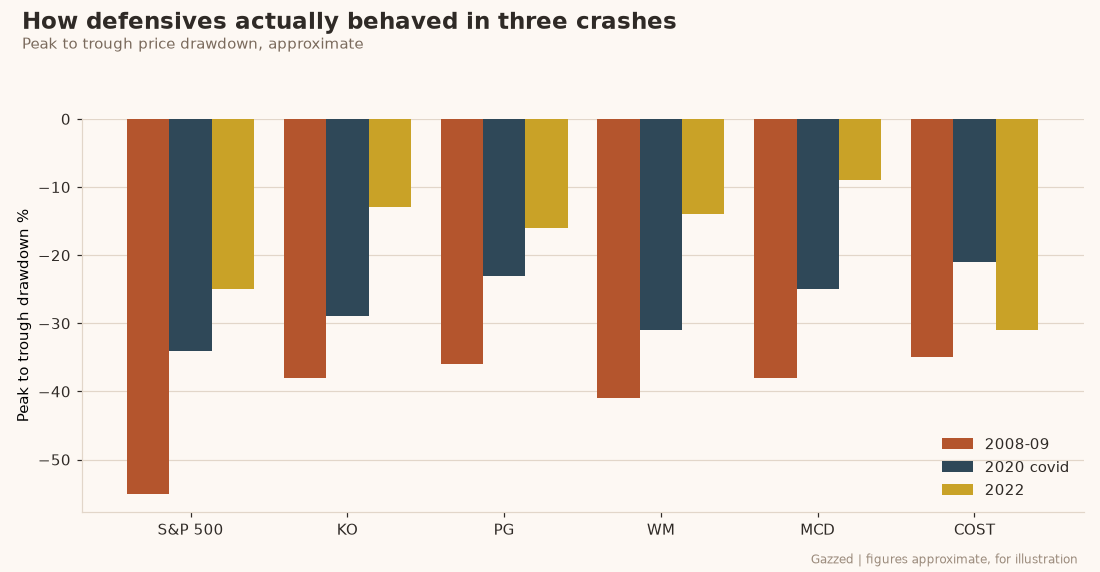
That chart is the evidence base for this entire article. Anybody can label a stock defensive. Far fewer names actually fell less than the index in 2008, again in the 2020 crash, and again in the very different 2022 rate driven selloff. Holding up in all three is the test I use.
The twelve, with the numbers that matter
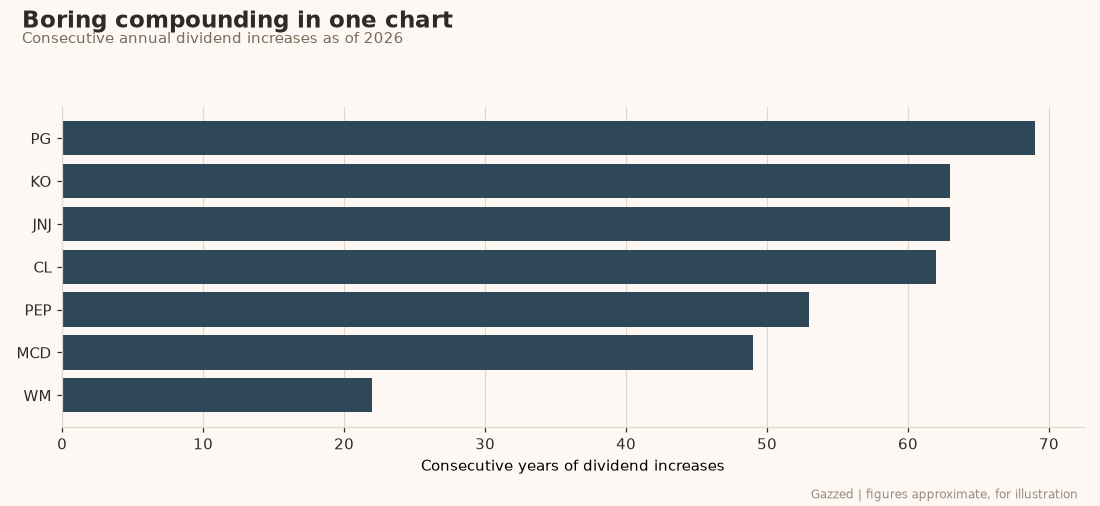
| Ticker | What it sells | Yield | Payout ratio | Div growth streak | 2008 drawdown |
|---|---|---|---|---|---|
| PG | Household and personal care | 2.6% | 60% | 68 years | -36% |
| KO | Beverages | 3.0% | 68% | 62 years | -35% |
| PEP | Snacks and drinks | 3.5% | 72% | 52 years | -38% |
| WM | Waste collection | 1.5% | 45% | 21 years | -38% |
| MCD | Fast food franchising | 2.4% | 58% | 48 years | +6% |
| COST | Membership retail | 0.6% | 28% | 20 years | -33% |
| JNJ | Pharma and medtech | 3.1% | 52% | 62 years | -28% |
| ABBV | Pharmaceuticals | 3.3% | 55% | 52 years combined | n/a |
| MDLZ | Packaged snacks | 2.8% | 50% | 12 years | n/a |
| CL | Oral and home care | 2.2% | 58% | 61 years | -28% |
| ADP | Payroll processing | 2.2% | 60% | 49 years | -40% |
| RSG | Waste and recycling | 1.2% | 40% | 21 years | -37% |
Five I would look at first
Waste Management: the most boring monopoly in America
Nobody is building a new landfill next to your town. Permits are close to impossible to obtain, which means existing sites are effectively irreplaceable assets with local pricing power. Contracts are typically multi year with inflation linked escalators built in, so revenue rises automatically. Volumes dip slightly in recessions because construction slows, but pricing more than covers it. Watch the core price metric and the landfill gas to energy projects, which add a high margin revenue line on top of the base business.
Costco: the membership is the business
Merchandise is sold at near cost. Nearly all the operating profit comes from membership fees, and renewal rates sit around 90 percent globally. In a downturn people trade down to bulk buying, so traffic goes up rather than down. The catch is valuation, which has been persistently expensive for years. I only add on genuine market wide selloffs, and I accept that I may simply never get a bargain price.
McDonald franchising: not really a restaurant company
Most locations are run by franchisees who pay rent and royalties. The revenue is therefore closer to a property and licensing stream than a food business, with the added benefit that consumers trade down into it when budgets tighten. It was one of only two Dow constituents to finish 2008 in positive territory, which is not a coincidence.
Procter and Gamble: pricing power in a bottle
Through the 2021 to 2023 inflation surge, P and G pushed through high single digit price increases with only mild volume loss. That is the cleanest demonstration of brand strength you will find. Growth is slow, the multiple is not cheap, and that is the deal you accept for stability.
ADP: defensive with a rate kicker
Payroll processing is deeply embedded in customer operations and almost never switched during hard times. ADP also earns interest on client funds it holds briefly before disbursing them, so higher rates add profit. Employment falls in a recession, which trims revenue per client, but the retention rate barely moves.
My five point defensive checklist
- Did revenue grow in 2009? Not profit, revenue. Accounting can hide a lot, top line cannot.
- Is the free cash flow payout ratio under 70 percent? Above that, a dividend cut becomes a live option in a bad year.
- Is net debt to EBITDA under 3 times, with debt maturities spread out rather than bunched?
- Can the company raise prices without losing volume? Check the last three years of price versus volume disclosure.
- Would demand exist if the customer lost their job tomorrow? If the honest answer is no, it is not defensive, it is just large.
Three mistakes I have made with defensive stocks
Chasing yield. In 2015 I bought a 9 percent yielder because the yield was 9 percent. It cut the dividend within a year and the share price halved. A high yield is usually the market telling you the payout is not safe.
Paying any price. Quality bought at 35 times earnings can go nowhere for a decade while the business does fine. That is exactly what happened to the great consumer staples of the early 1970s. Valuation discipline still applies to safe companies.
Selling too early. Twice I have rotated out of defensives into cyclicals because the recession never arrived, and twice I got the timing wrong in both directions. Now the allocation is fixed and rebalanced mechanically, which removes my opinion from the process.
A fair value sanity check
For slow growing defensive names I use a dividend discount approach rather than a multiple. Take the current dividend, assume it grows at the ten year average rate, and discount at 8 percent. If that produces a value below the current price, I am relying on multiple expansion rather than the business, which is a weak reason to own anything. Run it on Coca Cola with 5 percent dividend growth and you get a value in the high sixties to low seventies, which tells you the stock is fairly priced rather than cheap.
How much should sit in defensives
There is no universal number, but a useful frame is the amount you would need to avoid selling risk assets during two years of unemployment. For me that is roughly 20 percent of the equity portfolio, on top of a cash emergency fund. If you are ten years from retirement it should probably be higher. If you are 25 with stable income and a long horizon, it can be much lower.
If you would rather buy the whole basket in one trade, I compare the main defensive funds in the defensive ETF guide, and the broader ETF article covers how to build the growth side around it.
Which sectors historically hold up, and which only pretend to
Sector labels are a shortcut, and like most shortcuts they are right until they are not. Consumer staples, utilities, waste management and large pharmaceuticals have earned their reputation across multiple downturns because the underlying volumes genuinely do not move much. Healthcare is more nuanced than people assume. Drug sales and hospital procedures are sticky, but medical device makers tied to elective surgery see real deferrals when household budgets tighten, so the sector average hides a wide spread.
Telecoms are the classic example of a sector that sounds defensive and often is not. Demand for connectivity is inelastic, which is the good part, but the industry carries heavy debt loads and requires constant capital spending on networks. When credit markets tighten, that combination turns a stable revenue line into a stressed balance sheet. Real estate investment trusts have a similar problem. The rent cheque feels safe until you notice the refinancing schedule.
The other category worth flagging is what I think of as false defensives, which are simply very large companies. Size is not safety. Plenty of enormous businesses cut their dividends in 2009, and several of the biggest names of that era no longer exist in recognisable form. Market capitalisation tells you how popular a company was yesterday, not how resilient its cash flow will be tomorrow.
The signals I watch before a slowdown
I do not forecast recessions and I would advise against trying. What I do track is a handful of indicators that tell me how much stress is building, so that I can be more disciplined about rebalancing rather than more clever about timing.
- Credit spreads. The gap between high yield bond yields and Treasuries is the market honest opinion about corporate risk. When it widens quickly, equity weakness usually follows.
- Consumer delinquency rates. Credit card and auto loan delinquencies tend to turn up before unemployment does, because households borrow before they cut back.
- Company language. I read the same five earnings call transcripts every quarter and count how often management use the word cautious. It is unscientific and surprisingly informative.
- Inventory to sales ratios. Rising inventories with flat sales means production cuts are coming, which means layoffs are coming after that.
None of these tells me to sell. They tell me whether to direct new contributions toward the defensive sleeve or the growth sleeve, which is a much lower stakes decision and a far more forgiving one if I get it wrong.
Frequently asked questions
What is the most recession proof stock?
Judged purely on past drawdowns and demand stability, waste companies and large consumer staples come closest. None of them are immune to a market wide fall.
Do defensive stocks beat the market long term?
Usually not in total return, but they deliver similar returns with lower volatility over very long periods, and they make it far easier to stay invested.
Should I move to defensives if I expect a recession?
Timing that shift has a poor track record for most investors. A permanent allocation that you rebalance is more reliable than switching based on forecasts.
Educational content only, not financial advice. I hold several of these names. Do your own research before making any investment decision.