My cousin spent eleven months at home after finishing college. No job, no course, no training place, and a growing sense that the world had started without him. He is exactly what statisticians label NEET, which stands for not in education, employment or training, and which is a very clinical word for a period that usually feels like drowning quietly in a bedroom.
What he did have was about 40 pounds a week, most of it from occasional shifts helping a neighbour with deliveries. In October of that year he started putting 10 of it into a global index fund. He told nobody, because he assumed people would laugh at an unemployed 22 year old calling himself an investor. Four years later that account is worth more than 4,000 pounds, and more importantly, he has never stopped adding to it, including after he found work.

Read this before you invest a single pound
If you have no income, investing is not automatically the right move, and anyone who tells you otherwise is selling something. There are three things that come first, in this order.
Check every benefit and grant you are entitled to. In the UK that may include Universal Credit, council tax support, and the Help to Save scheme, which pays a 50 percent bonus on money saved by people on certain benefits. In the US it may mean SNAP, Medicaid, or state level programmes. A 50 percent guaranteed bonus outperforms every investment on Earth. Take the free money first.
Hold a small cash buffer. Even 300 pounds. When you have no income, a broken phone is not an inconvenience, it is the thing that stops you applying for jobs. Cash you can reach in an hour is worth more to you right now than shares that might be down 20 percent on the day you need them.
Clear anything above about 8 percent interest. Overdrafts, buy now pay later arrears, credit cards. There is no point earning a hoped for 7 percent while paying a certain 29 percent.
Only what is left over after those three should go into the market. For my cousin that was 10 pounds a week. It was enough.
What tiny amounts actually become
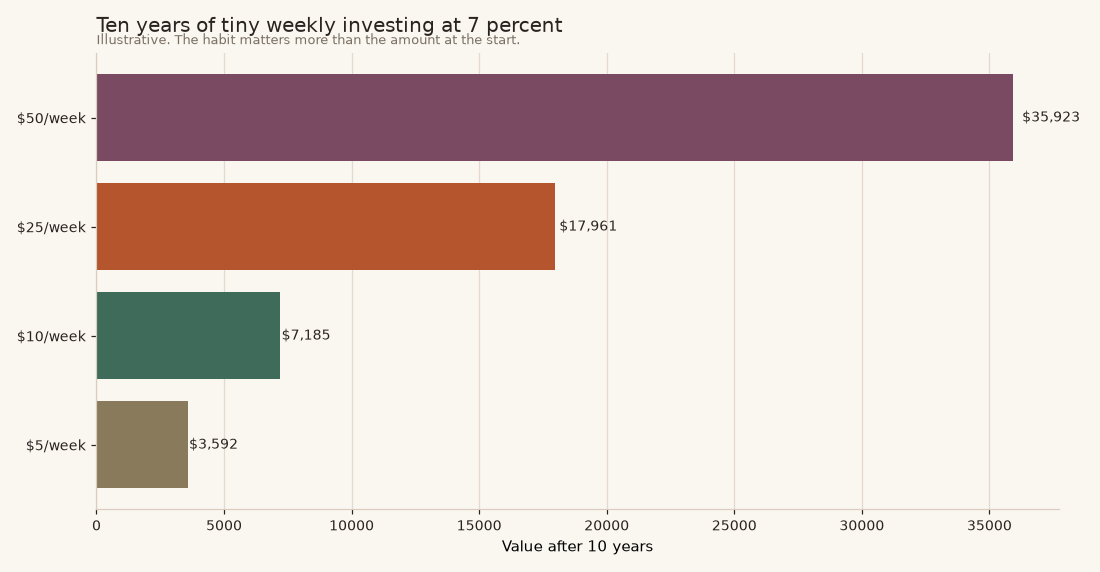
Five pounds a week for ten years is roughly 2,600 pounds of your own money and about 3,700 pounds of value. That will not change your life. What changes your life is that by year ten you have a decade of experience, an account that already exists, a habit that survives your first market crash, and the psychological fact of being a person who invests. When your income finally rises to 2,800 a month, you do not need to learn anything new. You just change one number in the app.
The account and the fund, in plain terms
This part is genuinely simple, and the industry has every incentive to make it feel complicated.
| Where you live | Account to open | Why |
|---|---|---|
| UK, age 18 to 39 | Stocks and Shares ISA, or a Lifetime ISA if buying a first home | All growth is tax free. The Lifetime ISA adds a 25 percent government bonus with strict withdrawal rules. |
| UK, under 18 | Junior ISA opened by a parent or guardian | Same tax treatment, locked until 18. |
| US, with any earned income | Roth IRA | Contributions can be withdrawn without penalty, growth is tax free in retirement. Requires earned income. |
| US, no earned income | Standard taxable brokerage account | No contribution limits, no earned income requirement, fully flexible. |
Inside that account, one fund is enough. A global all cap index fund or an S and P 500 index fund, accumulating rather than distributing if you want dividends reinvested automatically. That is the entire portfolio. You do not need eight funds, and eight funds will mostly hold the same companies anyway. If you want to understand what sits inside those funds, our breakdown of the best ETFs to buy in 2026 walks through the mechanics.
Fees are the one thing you fully control
You cannot control returns. You can control costs, and on small balances costs do disproportionate damage, because many platforms charge a flat monthly fee that eats a large percentage of a small pot.
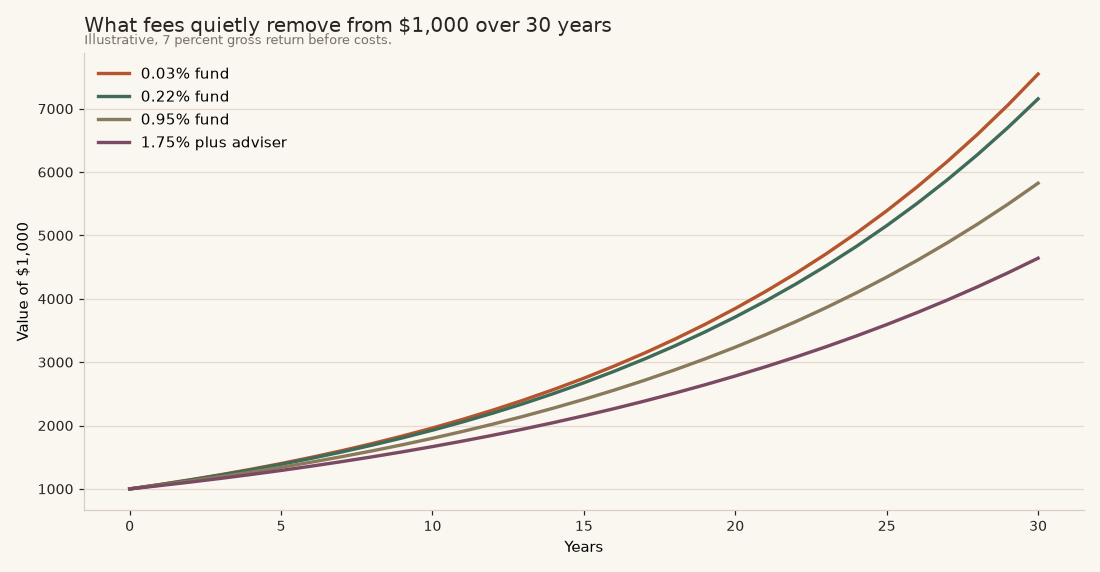
Three rules. Pay a percentage fee rather than a flat monthly fee while your balance is under a few thousand. Keep the fund charge under 0.25 percent a year. Avoid anything sold to you by somebody who contacted you first.
What to look at before you buy anything
If you stick to one index fund, the fundamentals you need are short. Read the fund factsheet and check four lines: the ongoing charge figure, the number of holdings, the top ten holdings as a percentage of the fund, and whether it is physically replicating rather than synthetic. A global fund holding 3,000 plus companies with a top ten under 25 percent and a charge under 0.25 percent is, for a beginner, close to the best available product in finance.
If you are tempted by individual shares, and most people are, cap it. Ninety percent index fund, ten percent whatever you find interesting. Then judge your picks after three years against what the index did. That ten percent will teach you more about your own temperament than any book.
Growing the deposit side, which matters more
Returns on 500 pounds are irrelevant. Contributions are everything at this stage, so the highest value work is income, not portfolio design.
My cousin's route was unglamorous. He learned spreadsheets properly from free material, which took six weeks, and that got him a temporary admin contract. Others I know have gone through a warehouse shift into logistics coordination, through tutoring a subject they were good at into full time teaching support, through a free cloud certification into an entry level support desk role. None of these are inspiring. All of them convert a NEET gap into a line on a CV within about three months.
Practical points that helped him. He kept applying on the days he felt worst, because momentum mattered more than mood. He treated volunteering two mornings a week as employment on his CV, which it is. And he told his adviser at the job centre exactly what he was doing, because some training funding is only offered if you ask.
The pipeline, from zero to a working portfolio
| Stage | What you do | Rough timeline |
|---|---|---|
| Foundation | Claim entitlements, hold 300 in cash, clear high interest debt | Month 1 to 3 |
| First account | Open an ISA or brokerage account, buy one global index fund | Month 3 |
| Habit | Automatic weekly or monthly transfer, however small | Month 3 onward |
| Income | Free certification, temporary work, volunteering that counts | Month 3 to 9 |
| Scale | Raise contributions with every income increase, never lifestyle first | Year 1 onward |
Things aimed directly at people in your position
Being young, online and short of money makes you the target market for the worst products in finance. Signals to walk away from: guaranteed returns, any mention of a course that teaches you to trade, copy trading services, contracts for difference, anything advertised by someone renting a car in the thumbnail, and any opportunity with a deadline. Legitimate investments are still there next week. That is how you tell.
If you are in the UK, check the firm on the Financial Conduct Authority register before you deposit. In the US, check FINRA BrokerCheck. It takes ninety seconds and it rules out most of the ways people lose everything.
An honest closing note
Investing will not solve unemployment. It is not a substitute for income, and anybody presenting it that way to a NEET audience is being irresponsible. What it does is quieter. It gives you one area of your life with a visible upward line at a time when most lines are flat, and it means that when work does arrive, the machinery is already built and running.
My cousin now earns a normal salary at a logistics firm and invests 380 pounds a month. He still refers to the account as his 10 pound habit. That is the right way to think about it.
What changes the day you do get paid
The transition from no income to a first salary is where most of the value of this preparation is realised, and it is also where most people quietly waste it. The pattern is predictable. Income arrives, lifestyle expands to meet it within about six weeks, and the investing habit stays frozen at the level it was when you had nothing.
The fix is a rule you set in advance. When income rises, split the increase in half. Half goes to your life, which you have earned and should enjoy, and half goes straight into contributions before you ever see it. My cousin moved from 10 pounds a week to 90 a month in his first role, then to 210 after a promotion, then to 380. At no point did the increase feel like a sacrifice, because he never lived on the higher figure first.
Two other things change on day one of employment. You become eligible for a workplace pension, which in the UK means automatic enrolment with an employer contribution of at least 3 percent, and in the US often means a 401k with a match. Never opt out of that, even during a probation period. It is the highest guaranteed return available to a working person. You may also become eligible for a Roth IRA in the US, since contributions require earned income, which opens a tax free account that a taxable brokerage cannot match.
The part nobody writes about
Being NEET is not primarily a financial condition. It is a confidence condition with financial consequences. The reason I think a tiny investing habit is worth more than its arithmetic is that it puts one thing in your week that is unambiguously forward moving, that nobody can reject you from, and that compounds whether or not the job market cooperates.
There is a practical version of this too. Understanding funds, fees, tax wrappers and compounding is genuinely employable knowledge. Two of the people I know who came out of a NEET period ended up in financial services, in one case because an interviewer asked what they had been doing and got a five minute answer about index tracking that was better informed than the interviewer expected.
If you are struggling with mood or motivation, and a lot of people in this position are, treat that as the higher priority. Speak to your doctor. Money systems can be automated and left alone for a year. Your health cannot.
This article is general information and education, not personal financial advice. Benefit and tax rules vary by country and change over time, so check the current rules for your own situation. Investments can fall in value and you may get back less than you put in.