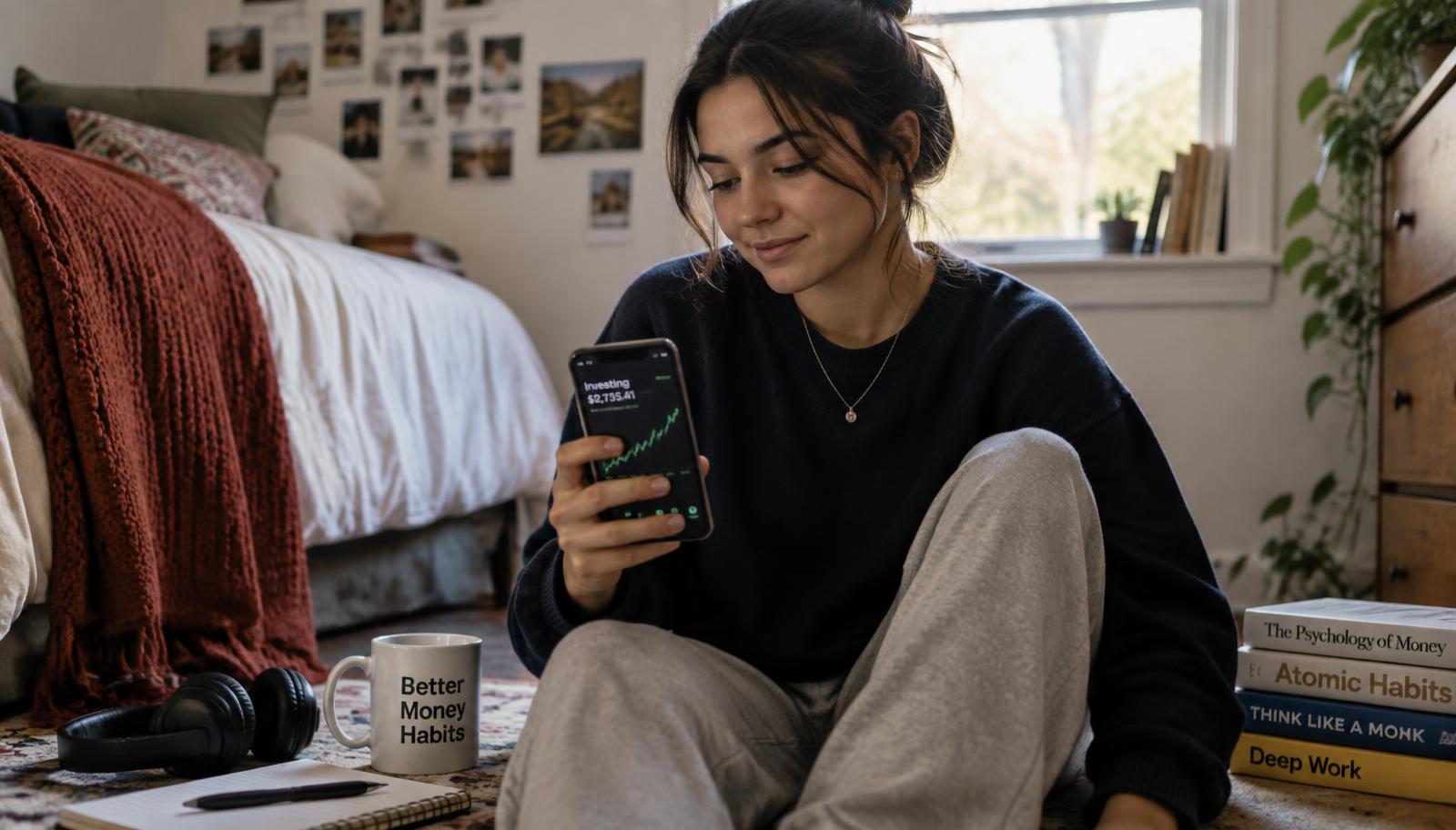
The first 1,000 dollars I ever invested went into a single mining company because a man on a forum had written three thousand words about it and sounded extremely certain. Within fourteen months it was worth 260 dollars. I have kept the screenshot of that position ever since, not out of nostalgia, but because it reminds me that confidence and analysis are completely different things.
The second 1,000 dollars went into a plain index fund I did not think about again for six years. That one quietly tripled. This article is written from the wreckage of the first decision and the boredom of the second.
One question decides everything: when do you need it back?
Before comparing any product, answer this. Money you need within two years should not be in the stock market, full stop. Not because shares are bad, but because their normal behaviour includes falling 20 percent for eighteen months at a time. Money you will not touch for ten years belongs almost entirely in equities, because the biggest risk over that horizon is not volatility, it is inflation.
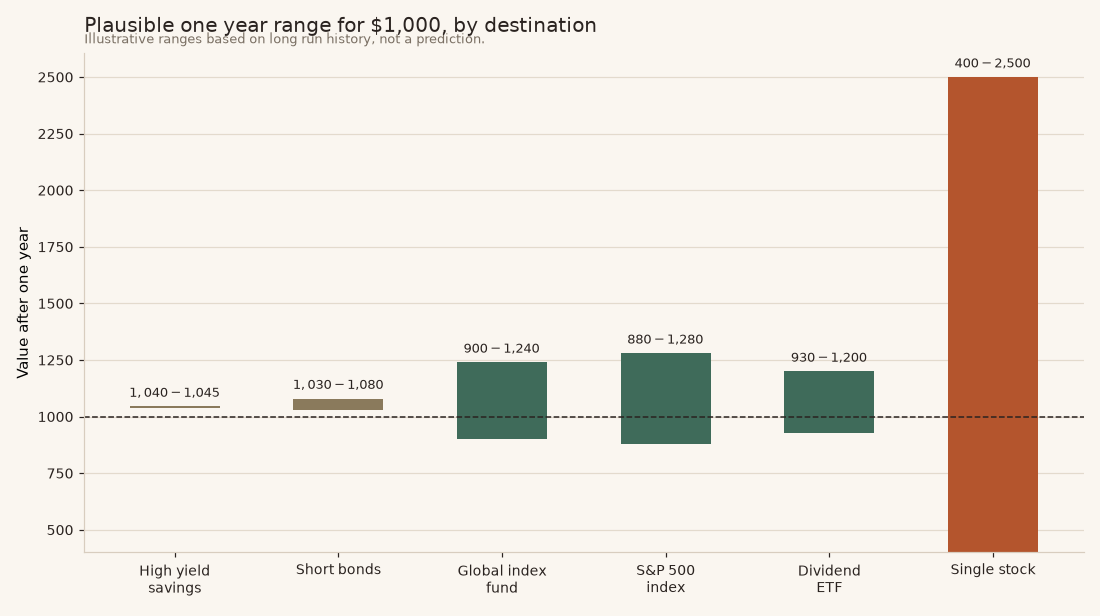
Seven destinations, ranked by who they suit
1. High yield savings or a money market fund
Best for money needed within two years, or for the first 1,000 of an emergency fund. Rates on the better accounts have tracked close to central bank rates, and the money is available the same week. The fundamentals to check are simple: the headline rate, whether it is a bonus rate that drops after twelve months, and whether the provider is covered by deposit protection, which is 85,000 pounds in the UK and 250,000 dollars in the US. Expected outcome is modest and highly predictable, which is exactly the point.
2. Paying off a credit card
Unglamorous and mathematically unbeatable. Clearing 1,000 dollars of balance at 23 percent APR is a guaranteed, tax free 230 dollars a year return. No equity investment offers a guaranteed anything. If you are carrying a revolving balance, the honest answer to where to invest 1,000 dollars is here, and every other section of this article can wait.
3. A total market or global index fund
The default answer for most people with a horizon beyond five years. One fund buys a slice of thousands of companies across dozens of countries, rebalances itself, and charges under a quarter of a percent. The fundamentals worth checking on the factsheet are the ongoing charge, the number of holdings, the concentration of the top ten, and the tracking difference against the index over three years. Our full walkthrough of the best ETFs to buy in 2026 covers the specific tickers most people use as a core.
4. An S and P 500 fund
Higher concentration, higher historical return, and considerably more exposure to a handful of very large technology companies than most investors realise. Roughly a third of the index now sits in its ten largest members. That has been a tailwind for a decade and is a genuine risk factor going forward. Reasonable as a core for someone who understands that trade off, better still when paired with an international fund.
5. A dividend or quality income ETF
Suits investors who want visible cash coming in and a smoother ride in downturns. Screen for payout ratio and dividend growth rather than headline yield. A yield above 7 percent in a broad fund usually indicates that the market expects the underlying payments to be cut. Total return, meaning income plus price, is what actually matters, and high yield funds have historically lagged the broad market during strong growth years.
6. Short dated government bonds
For a two to four year horizon, a short duration treasury or gilt fund gives a known yield with much less price sensitivity than long bonds. Check the effective duration, which tells you roughly how much the fund moves for each one percent change in rates, and the yield to maturity, which is a far better estimate of future return than the distribution yield.
7. An individual stock
Fine with a slice, dangerous with the lot. If you want to do it, do the work properly: revenue growth over three years, gross and operating margin direction, free cash flow conversion, net debt to EBITDA, insider ownership, and a valuation you can defend out loud. Then write down, before buying, what would make you sell. Our analysis of AI stocks for 2026 and of energy stocks both show the format that work takes.
Three allocations for 1,000 dollars
| Profile | Allocation | Why |
|---|---|---|
| Money needed within 2 years | 1,000 in high yield savings | Capital certainty beats expected return over short horizons. |
| First long term investment | 1,000 in a global index fund | Maximum diversification per dollar, minimum decisions to get wrong. |
| Experienced, 10 year horizon | 700 global index, 200 dividend ETF, 100 one researched stock | Core plus a deliberately capped learning allocation. |
All at once, or spread it out?
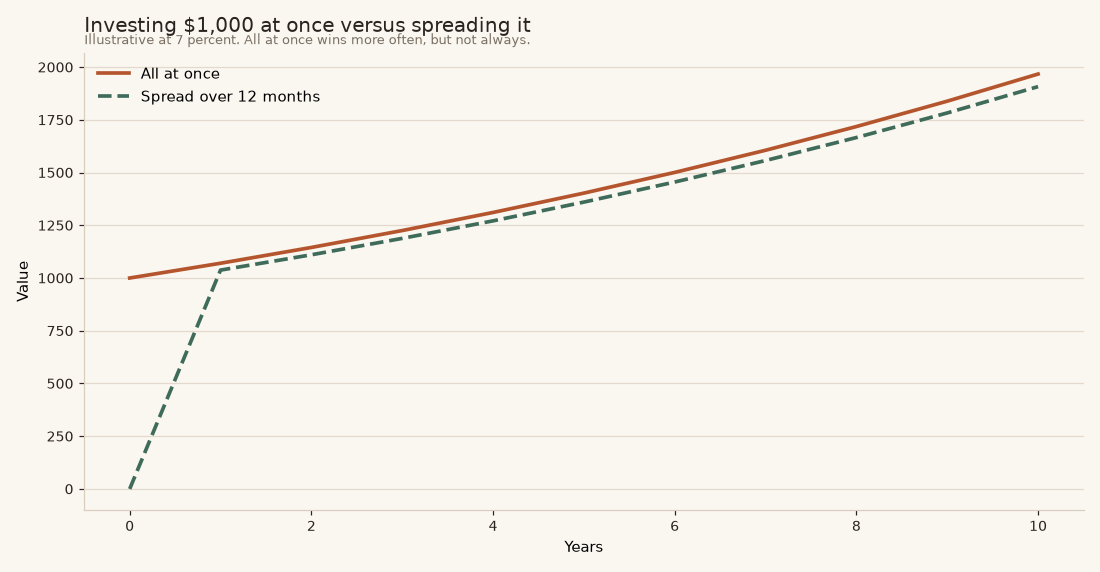
Historical studies generally find that lump sum investing beats spreading it over twelve months roughly two thirds of the time. The counter argument is behavioural rather than mathematical. If putting the full amount in on Monday and seeing it down 12 percent by Friday would make you sell, then splitting it into four monthly instalments is a rational price to pay for staying invested. On 1,000 dollars the difference in expected outcome is small. The difference in whether you panic is not.
Price targets, and how to read them honestly
Analyst price targets attract clicks and deserve scepticism. A target is an output of a model, and the model is mostly two assumptions: what earnings will be, and what multiple the market will pay for them. Change either by 15 percent and the target moves dramatically.
If you want to build your own rough target for a broad index fund, the honest version is: expected return is roughly the dividend yield plus expected earnings growth plus or minus any change in valuation. For a global equity fund that currently gives something in the region of 6 to 8 percent a year over long periods, with enormous variation in any single year. That is a range, not a promise, and any source giving you a precise figure for next year is guessing with more confidence than the data supports.
Five ways people ruin a good 1,000 dollars
Buying eight overlapping funds and calling it diversification. Using a platform with a flat monthly fee that consumes 3 percent of a small balance each year. Checking the balance daily, which converts normal volatility into stress and stress into selling. Following a social media account that is paid to promote products. And, the most expensive of all, waiting for a better entry point that never announces itself, which is exactly what I did for eleven months in 2016 while the market went up 19 percent without me.
What I would actually do this afternoon
If there is a credit card balance, pay it. If there is no cash cushion, build one to 1,000 first and start investing next month. If both of those boxes are ticked, open a tax sheltered account, buy one global index fund with the whole 1,000, set a 50 dollar monthly automatic contribution, and then do the genuinely difficult part, which is not looking at it again until the same date next year.
The first thousand is rarely the one that makes you money. It is the one that teaches you to keep going.
Put it in the right account before you pick the fund
The wrapper around your 1,000 dollars often matters more than the choice between two similar funds. A 0.05 percent difference in fund charge is worth 50 cents a year on this balance. Holding the same fund in a tax sheltered account rather than a taxable one can be worth far more than that over a decade.
| Country | First choice | Why |
|---|---|---|
| UK | Stocks and Shares ISA | No tax on growth, dividends or withdrawals, and no reporting. |
| UK, first home within ten years | Lifetime ISA | A 25 percent government bonus, with penalties for other uses. |
| US, with earned income | Roth IRA | Tax free growth, and contributions can be withdrawn at any time. |
| US, employer match available | 401k up to the match | An immediate guaranteed return before any market exposure. |
One warning specific to small balances. Some platforms charge a flat administration fee of five to ten a month. On 1,000 dollars that is up to 12 percent a year before you earn anything, which no fund selection can overcome. Choose a platform that charges a percentage of assets, or one with no account fee for small holdings.
What to do with the next thousand, and the one after
The reason the first 1,000 matters is that it establishes the machinery. The real outcome depends on what happens for the following ten years, and the honest answer is that it should be repetitive to the point of dullness.
Set a standing transfer on payday. Keep buying the same fund regardless of headlines. Increase the amount whenever your income rises. Rebalance once a year if you hold more than one fund, which takes about ten minutes. Read your platform's annual statement, confirm the charges, and then close it.
The thing that will test you is the first serious decline. Markets have fallen more than 30 percent several times in the last three decades, and each of those periods felt, at the time, like the end of something rather than a phase of something. The single behaviour that separated the people I know who built wealth from the people who did not was not stock selection. It was continuing to buy in 2008, in 2020 and in 2022 when the account balance was going the wrong way and every instinct said to stop.
This article is general information and education, not personal financial advice. Charts are illustrative and based on long run historical ranges rather than predictions. Investments can fall in value and you may get back less than you put in.