For years I believed exercise only counted if I had a full hour to do it properly. An hour at the gym? Great. A long run? Even better. But ten or fifteen minutes squeezed between everything else? Somehow that never felt like enough. Then a study landed in 2026 that made me rethink the whole idea. Researchers including Paul Cohen at The Rockefeller University compared the body's molecular response to a few minutes of all out sprinting with 90 minutes of steady, moderate cycling. What they found was striking: intensity, not duration, drove the biggest changes in the bloodstream.
Before we go any further, let me be honest about what this research does and does not say, because the headline version travelling around the internet ("three minutes beats ninety") is not quite what the scientists showed. The truth is more interesting, and more useful.
Can 3 minutes of sprinting really make a difference?
I think a lot of us fall into the same trap I did. We know exercise is good for us. The difficult part is fitting it into real life. Work runs late. The children need something. There is dinner to make. You are tired. You look at the clock, realise you do not have an hour, and tell yourself you will exercise tomorrow instead.
That is why this research caught my attention. The peer reviewed study, published in Cell Reports Medicine in 2026, found that exercise intensity distinctly affected circulating proteins and metabolites involved in communication between tissues and organs. In plain language: your body may care a great deal about how hard you exercise, not simply how long.
That does not mean longer exercise suddenly stopped mattering. But it challenges the idea that a worthwhile workout always has to swallow a big chunk of your day.
What did the sprinting study actually do?
This is where we need to get past the headline. The acute experiment included 19 young, active, metabolically healthy men. Ten completed sprint interval exercise. Nine completed moderate intensity exercise.
The moderate session was 90 minutes of continuous cycling at an intensity based around each participant's first lactate threshold. Steady, honest work. The sprint protocol was completely different: six 30 second all out cycling sprints, with four minutes of recovery between each one.
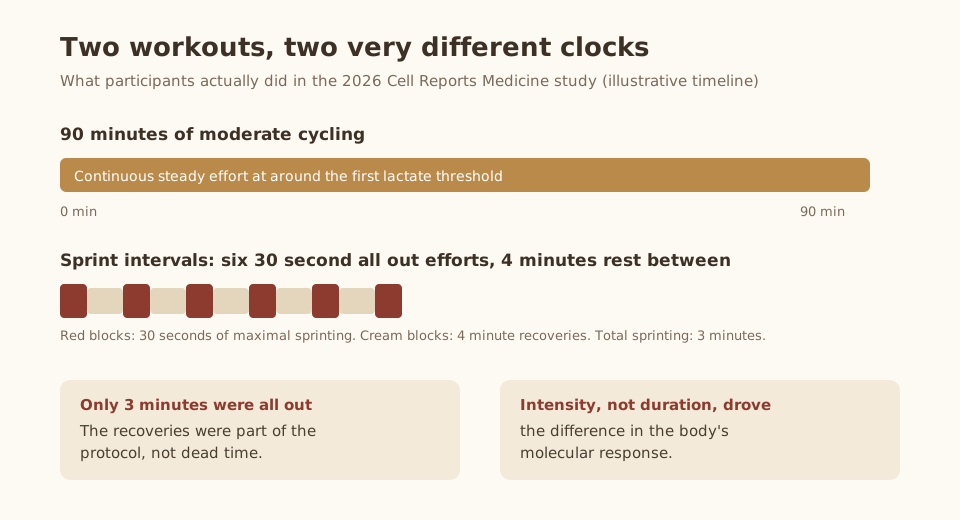
That gives us three minutes of actual maximal sprinting. But notice something important: this was not a three minute workout from beginning to end. The recovery periods were an integral part of the protocol. "Three minutes of exercise beats 90" makes a wonderful headline. It is not what the researchers demonstrated.
What happened after the sprints?
The researchers collected blood plasma before exercise, immediately after, and three hours later. Then they examined changes in the plasma proteome and metabolome, the shifting population of proteins and small molecules circulating in the blood.
Here is the way I think about it. Your bloodstream is a communication network. Your muscles are not working in isolation when you exercise, and neither are your heart, your fat tissue or your liver. Exercise triggers the release and regulation of molecules that can carry signals from one part of the body to another. Scientists call these exercise regulated secreted factors exerkines.
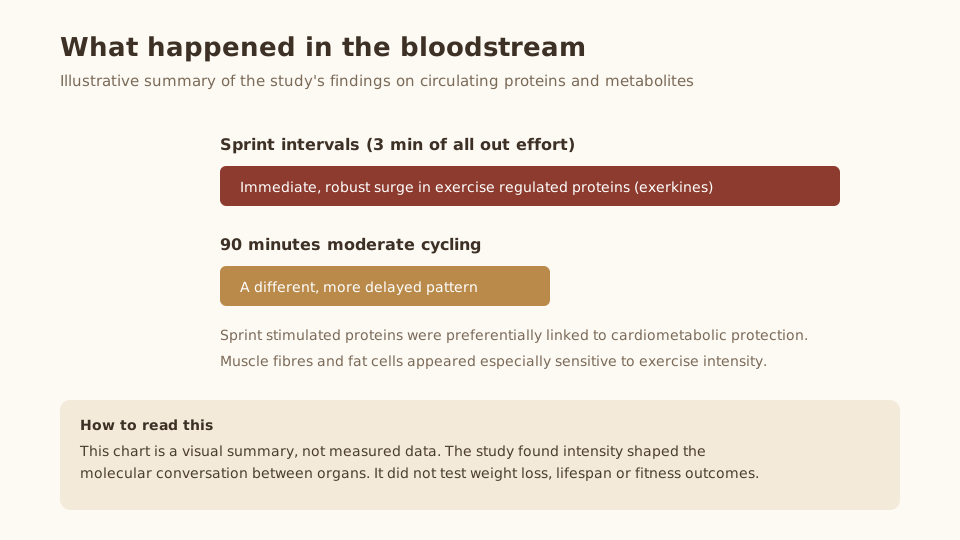
The sprint intervals produced immediate and robust changes in the plasma proteome. The moderate session produced a different pattern, including more delayed secretory responses. In other words, the two workouts were not simply different length versions of the same biological event. Intensity changed the molecular conversation happening inside the body.
Why were hundreds of proteins changing?
This is the part I find most fascinating. We have known for a very long time that exercise is good for us. Regular physical activity is associated with benefits across cardiovascular, metabolic and overall health. But knowing exercise is beneficial and understanding how working muscles communicate those benefits to distant tissues are two different things.
The researchers tried to map exercise regulated proteins to their predicted tissues of origin and destination. Their analysis suggested that multiple tissues participate in this exercise induced communication, and that muscle fibres and adipocytes, the cells that make up much of our fat tissue, appeared particularly sensitive to exercise intensity.
They also connected the intensity dependent proteins with cardiometabolic health and disease data. Their conclusion was not simply that sprinting burns more calories. It was much more interesting: exercise intensity appears to influence communication between organs, and sprint stimulated proteins were preferentially associated with cardiometabolic protection. That gives scientists another piece of the puzzle explaining why different forms of exercise can produce different adaptations.
Your body does not simply count exercise minutes
This research changed the way I think about the clock. Your body does not know whether your workout lasted 15 minutes or whether your fitness app awarded you a badge for exercising for an hour. It responds to physiological demand.
A relaxed walk creates one type of challenge. A moderate bike ride creates another. An all out 30 second sprint is something else entirely. During intense exercise, energy demand rises dramatically. Your muscles need fuel quickly. Your cardiovascular system responds. Metabolic processes change. Blood lactate rises. And the new research suggests the molecular signals circulating throughout the body change substantially too.
That does not make one type of exercise universally superior. It tells us that different intensities create different biological signals. If you are curious about how effort, waistline and stress tie together, our piece on the cortisol belly seven day routine looks at the gentler, daily habits side of the same story.
Why this changed how I think about short workouts
There is something psychologically freeing about this. I have had days when I skipped exercise entirely because I could not find an hour. Maybe you have done the same. You look at your schedule and think: there is no point, I only have 15 minutes.
But perhaps that is the wrong way to look at it. A short, appropriately challenging workout is not necessarily a failed version of a long workout. It can be a different kind of workout. That distinction matters because lack of time remains one of the most common practical barriers to regular exercise. The workout you can realistically fit into your life has an enormous advantage over the perfect workout that never happens.
Does this mean you only need 3 minutes of exercise?
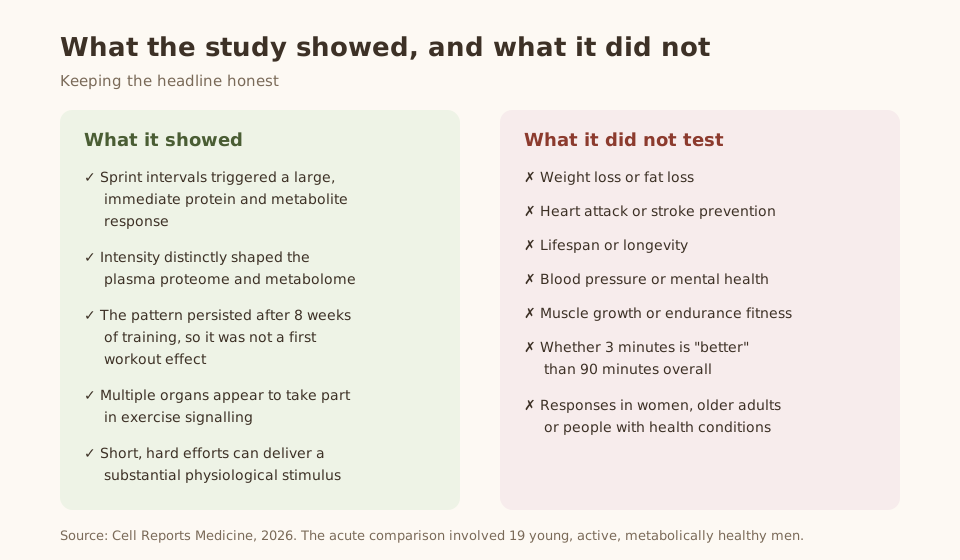
No. This is probably the most important part of the article. The study does not prove that three minutes of sprinting gives you every benefit of 90 minutes of moderate exercise. The researchers were measuring changes in proteins, metabolites and predicted interorgan communication. They were not testing whether three minutes of sprinting was superior for:
- Longevity
- Heart attack or stroke prevention
- Blood pressure
- Mental health
- Muscle growth
- Endurance
- Weight loss
- Bone health
- Long term cardiovascular fitness
Those are different questions, and many of them still favour doing more total movement across the week. The finding is still exciting. We just should not transform an interesting molecular study into a promise the research never made.
The workout was not really only 3 minutes long
This deserves repeating because it is the detail most likely to disappear when the research is shared online. The participants performed six 30 second all out cycling efforts. That is three minutes of sprinting. But there were four minute recovery periods between efforts, and recovery is fundamental to sprint interval training.
Imagine trying to sprint at your absolute maximum continuously for several minutes. You could not maintain the intensity. Recovery lets the body partially restore itself so another very high effort becomes possible. So a more accurate description of the study is: a workout containing three minutes of all out sprinting produced a striking molecular response compared with 90 minutes of moderate cycling. Slightly less dramatic than "three minutes beats 90". Scientifically much more accurate. And frankly, I still find it impressive.
What happened after 8 weeks of training?
Another strength of the research is that the scientists did not only look at a single unfamiliar session. They also examined exercise responses before and after eight weeks of training, and exercise intensity continued to distinctly influence the plasma proteome and metabolome in trained as well as untrained participants.
That matters because our bodies adapt. The first time you perform an unfamiliar workout, the physiological response can look very different from what happens after you have been doing it regularly. The persistence of intensity dependent differences strengthens the idea that intensity itself, not novelty, drives these molecular signals.
The study had an important limitation
The acute comparison involved just 19 young, active, metabolically healthy men. That is a small and very specific group. We do not know from this experiment whether the molecular response would look exactly the same in women, older adults, sedentary people, people living with obesity, people with diabetes or cardiovascular disease, people taking certain medications, or highly trained endurance athletes.
This does not make the research unimportant. Small mechanistic studies can tell us fascinating things about human physiology. It simply marks the boundaries of the evidence. A finding in 19 healthy young men should not automatically become a prescription for everyone.
Sprinting is powerful, but it is not gentle
An all out sprint means exactly that. These participants were not casually increasing the resistance on a stationary bike. They were performing maximal efforts, and that is demanding. Someone who exercises regularly may tolerate vigorous intervals well. For someone who has spent years sedentary, suddenly attempting six maximal sprints could be an entirely different experience. Muscles, tendons and joints all have to tolerate the mechanical load, and vigorous exercise places greater acute demands on the cardiovascular system.
You do not need to prove anything to your body. Exercise is not punishment. If you are carrying extra weight or have not trained in years, build a base of walking and steady cycling first, and check where you stand with our BMI calculator and longevity calculator before you add intensity. If you have a heart condition, chest symptoms, uncontrolled blood pressure or any doubt, speak to your doctor before attempting all out efforts.
How to apply this without hurting yourself
If you are reasonably healthy and already active, here is a sensible way to borrow the spirit of the study:
- Warm up properly. Ten minutes of easy cycling, jogging or brisk walking, plus a few gentle accelerations.
- Start short. Try two or three 20 to 30 second hard efforts on a bike or hill, with generous easy recovery between, before you ever attempt six.
- Keep the recoveries. They are part of the method, not wasted time.
- Prefer low impact options. A stationary bike, uphill walk or swim sprints are kinder to joints than flat out track sprinting.
- Once or twice a week is plenty. Vigorous intervals are a seasoning, not the whole meal. Keep your walks, easy rides and strength work.
- Stop if anything feels wrong. Chest pain, dizziness or unusual breathlessness means stop and get checked.
If you are helping a young person build healthy habits, our kids BMI calculator uses age and sex specific charts rather than adult cut offs.
Frequently asked questions
Is 3 minutes of sprinting better than 90 minutes of exercise?
Not exactly. The 2026 study showed three minutes of all out sprinting (within a longer interval session) produced a stronger immediate molecular response than 90 minutes of moderate cycling. It did not compare long term outcomes like weight loss, fitness, blood pressure or lifespan, so it cannot tell us which workout is "better" overall.
How many calories does sprint interval training burn?
That was not what this study measured. Sprint intervals burn energy during and after the session, but total calorie burn depends on your size, effort and the full length of the workout including recoveries. Do not choose intervals purely for calorie maths.
Is sprint interval training safe for beginners?
All out sprinting is a maximal effort and places real demands on the heart, muscles and joints. Beginners should build a base of walking and steady cycling first, start with fewer, shorter efforts on low impact options like a bike, and speak to a doctor first if they have any cardiovascular risk factors or symptoms.
What are exerkines?
Exerkines are molecules released or regulated during exercise that can carry signals between tissues and organs. Researchers think they help explain how working muscles produce benefits in distant parts of the body, and this study suggests exercise intensity shapes which exerkines circulate.
How often should you do sprint intervals?
For most healthy, already active people, one or two sessions a week is a sensible ceiling, layered on top of regular walking, easy cardio and strength training. Recovery between sessions is where adaptation happens.
The bottom line
The honest summary is this: a workout containing just three minutes of all out sprinting set off a remarkably large molecular response, bigger in key ways than 90 minutes of steady cycling, and the effect persisted after weeks of training. Intensity talks to your organs in a language duration alone does not speak. But the study was small, the participants were young healthy men, and it measured molecules, not long term outcomes.
For me, the real gift is psychological. The next time you only have 15 minutes, do not write the day off. A short, genuinely challenging workout is not a consolation prize. It is a different kind of stimulus, and your body is listening.
Sources
- Cell Reports Medicine (2026): exercise intensity distinctly influences the plasma proteome and metabolome; study led by researchers including Paul Cohen, The Rockefeller University.
- The Rockefeller University: research on interorgan communication during exercise.
- World Health Organization: physical activity guidelines, including vigorous intensity options.
- NHS: physical activity guidelines for adults, where 75 minutes of vigorous activity counts comparably to 150 minutes of moderate.
Medical disclaimer: This article is for general information only and is not medical advice. Maximal intensity exercise is not suitable for everyone. Speak to your doctor before starting sprint intervals if you have a heart condition, high blood pressure, chest symptoms, joint problems, or if you have been inactive for a long time.