In March 2014 I had 62 pounds in my current account, a credit card I was too scared to open the statement for, and a job that paid me on the 28th of every month. I remember standing in a supermarket doing mental arithmetic on a bag of rice. I was not poor in the way that makes headlines. I was just broke in the ordinary, grinding way that millions of people are broke, where there is always money coming in and never any money left.
Twelve years later I have a portfolio, a paid off car, and a mortgage that no longer frightens me. Nothing dramatic happened in between. No inheritance, no crypto windfall, no viral business. What happened was a series of small, boring decisions repeated for long enough that the maths started doing the heavy lifting instead of me. This article is that process, written out properly, with the numbers I actually used.

What wealth actually is, in one sentence
Wealth is not income. Wealth is the gap between what you earn and what you spend, invested for long enough to start earning on its own. That is the whole subject. A surgeon on 400,000 dollars a year who spends 400,000 dollars a year has a high income and no wealth. A nurse who invests 700 dollars a month for 25 years has a modest income and, by most measures, a rich retirement.
The reason this matters is that it tells you exactly where to aim. There are only three levers: earn more, spend less, invest the difference well. Most financial content obsesses over the third lever because it is the most fun to talk about. In the first five years, the first two do almost all the work.
The maths that makes it work
Here is the chart I wish someone had put in front of me in 2014. It shows what a steady monthly investment becomes at a 7 percent annual return, which is roughly the long run average of a global equity index after inflation is partly accounted for and well before anyone can promise it to you.
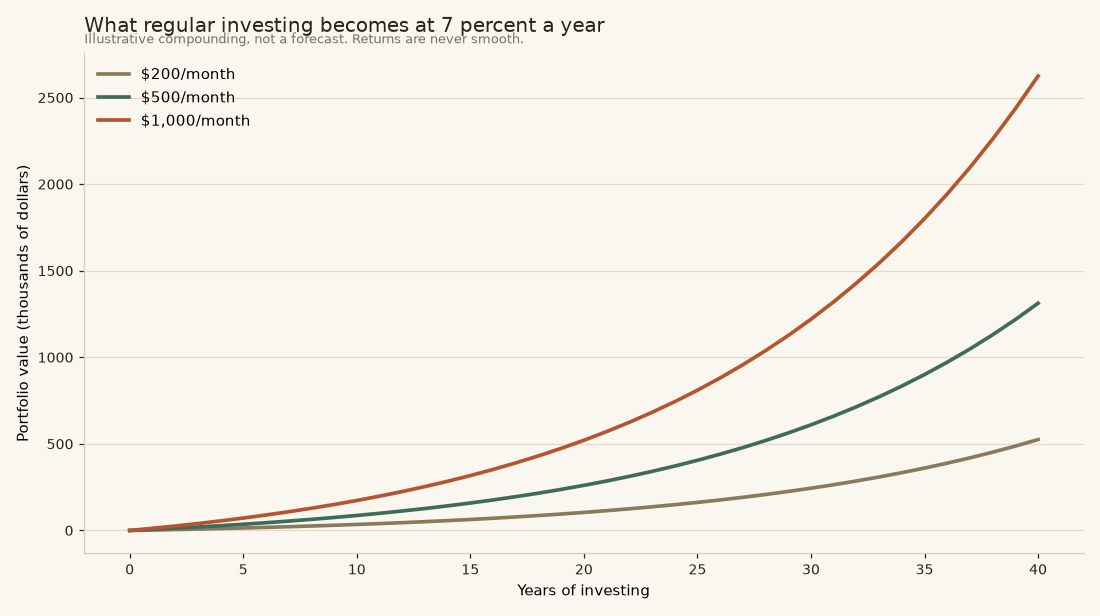
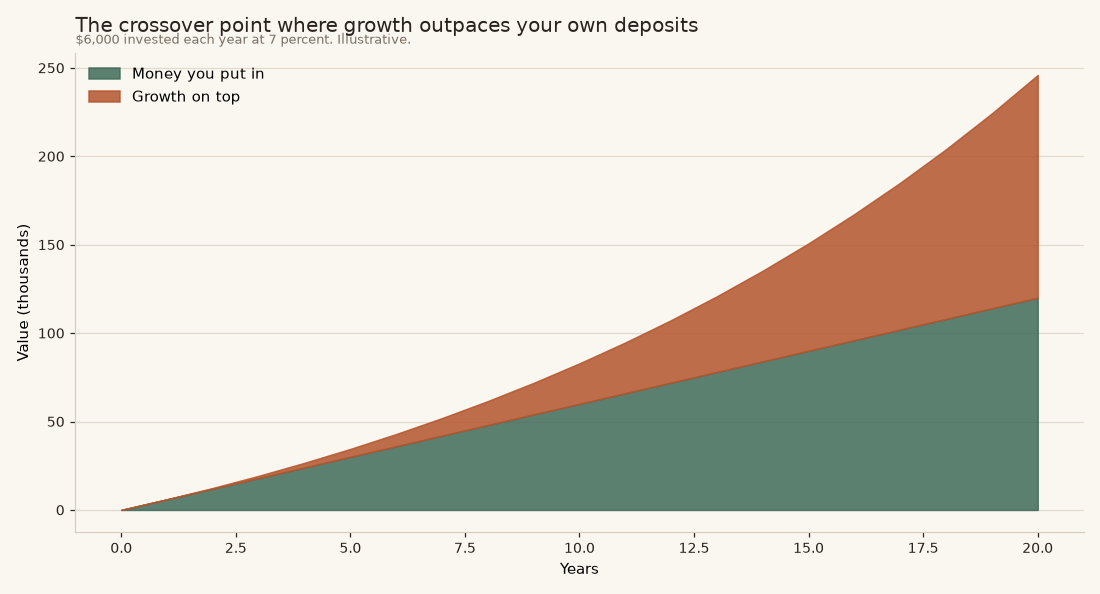
Notice the shape. For the first eight to ten years the lines are almost straight, because nearly all of the balance is money you deposited. Somewhere around year twelve the curve bends. That bend is the entire point of the exercise, and it is why quitting in year four feels so rational and is so expensive.
Your savings rate matters more than your salary
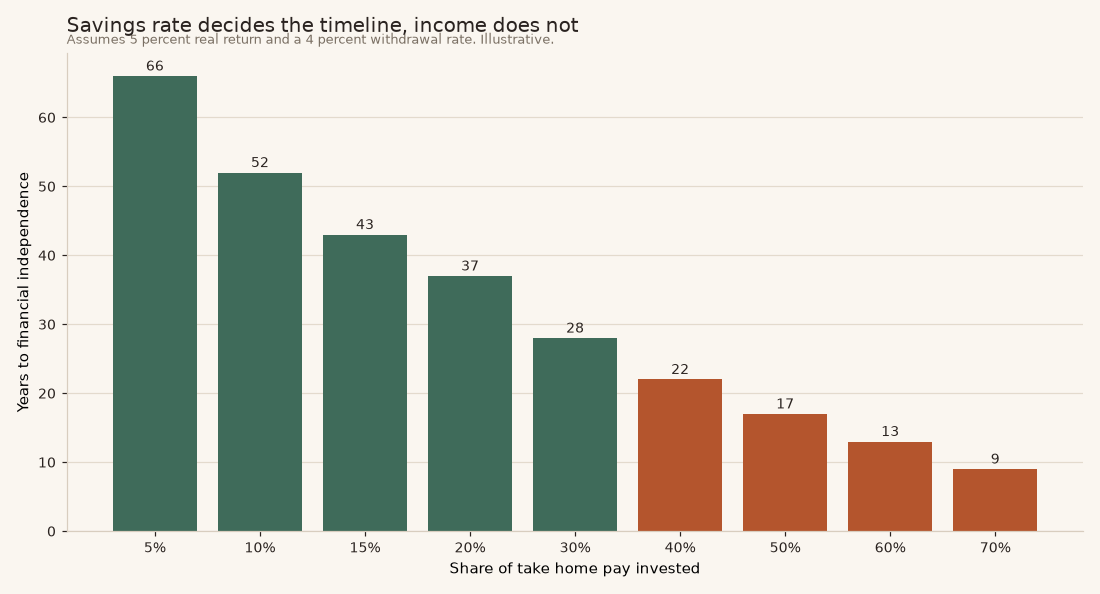
This is the single most counterintuitive idea in personal finance, and it is arithmetically undeniable. The years it takes you to become financially independent depend almost entirely on the percentage of your take home pay you invest, not the absolute amount. Somebody investing half of a 45,000 dollar income reaches independence years before somebody investing a tenth of a 150,000 dollar income, because the first person also needs a much smaller pot to cover a much smaller lifestyle.
| Savings rate | Rough years to independence | What this looks like day to day |
|---|---|---|
| 10 percent | Around 50 | The default. A full working life plus a pension. |
| 20 percent | Around 36 | Comfortable, achievable for most dual income households. |
| 35 percent | Around 25 | Requires a deliberate housing and transport decision. |
| 50 percent | Around 17 | Usually needs a strong income, a small footprint, or both. |
The order of operations I would give anyone starting today
Sequence matters more than sophistication. This is the order I used, and it is the order I would repeat.
One. A starter cushion of 1,000 to 2,000 dollars. Not six months yet. Just enough that a tyre, a boiler or a vet bill does not go on a credit card at 24 percent. This one step breaks the debt cycle for more people than any other.
Two. Free employer money. If your workplace pension or 401k matches contributions, contribute at least to the match. A 100 percent match is an instant, risk free doubling of that money. Nothing else in finance offers that.
Three. Kill debt above roughly 8 percent. Credit cards, car finance, payday products, store cards. Paying off a 22 percent card is a guaranteed 22 percent return. No fund manager alive can promise that.
Four. Build the cushion out to three to six months of essential spending. Keep it in a high yield savings account or a money market fund, not in shares. Its job is availability, not growth. Our inflation erosion calculator shows what cash quietly loses over decades, which is exactly why this pot should be sized and then capped.
Five. Invest the rest in broad, low cost index funds. A single global equity fund at under 0.25 percent a year is a complete answer for most people in their twenties and thirties. If you want to see what individual holdings on top of that core look like, our guide to the best ETFs to buy in 2026 goes through five tickers in detail.
Six. Only then get clever. Property, individual shares, side businesses, private investments. These can absolutely work. They also demand time, skill and stomach, and they are not where a beginner should start.
The fundamentals to track, quarter by quarter
People track the stock market daily and their own finances never. Reverse that. Four numbers, once a quarter, in a spreadsheet that takes ten minutes to update.
| Metric | How to calculate | A healthy trend |
|---|---|---|
| Net worth | Everything you own minus everything you owe | Rising, even slightly, in most quarters |
| Savings rate | Invested amount divided by take home pay | Up by one or two points a year |
| Fixed cost ratio | Rent, debt, insurance and utilities over take home pay | Under 55 percent, ideally under 50 |
| Runway | Liquid cash divided by monthly essentials | Three to six months, held steady |
I have kept this spreadsheet since 2015. The most useful thing about it is not the number at the bottom. It is that on the months where I felt like I was going backwards, the file usually disagreed with me.
The big three decisions that dwarf everything else
You can cancel every subscription you own and save perhaps 60 dollars a month. Useful, not transformative. Three decisions actually move the needle, and each one is worth thousands a year.
Housing. If rent or mortgage plus bills exceeds a third of your take home pay, nothing downstream will feel easy. Moving one neighbourhood out, taking a flatmate for two years, or negotiating a renewal rather than accepting the asking rent are the highest value hours you will spend on money all year.
Transport. A financed new car at 550 dollars a month, plus insurance, fuel and depreciation, is a real cost near 900 dollars a month. The same money invested from age 30 to 60 at 7 percent is a seven figure difference. Buying a three year old car with cash is the single most common decision I see behind quiet, unglamorous wealth.
Income. Frugality has a floor. Income does not. The largest jumps in my own savings rate came from two job moves and one certification, not from any budget. Ask for the raise, apply for the role, do the qualification. A 12 percent pay rise banked straight into investments beats a decade of clipping coupons.
Four mistakes I made so you do not have to
I sold everything in March 2020 and bought back six weeks higher. That single panic cost me more than every fee I have ever paid combined. I also held a cash ISA earning almost nothing for three years because it felt safe, chased a dividend yield of 11 percent that turned out to be a company in trouble, and spent two years optimising a budget while ignoring the fact that I was underpaid by about 15 percent.
The pattern in all four is the same. I paid attention to the things that felt urgent and ignored the things that were merely important. Building wealth is almost entirely a defence against your own attention.
A ten year plan you could start this weekend
Year one: build the 1,000 dollar cushion, capture the employer match, list every debt by interest rate. Years two and three: clear high interest debt, extend the cushion to three months, start a 100 dollar monthly automatic investment on payday so you never see the money. Years four and five: push the savings rate toward 20 percent, review housing and transport once, increase contributions with every pay rise. Years six to ten: change almost nothing, keep investing through at least one frightening market decline, and let the curve bend.
That is genuinely it. There is no step eleven where it becomes exciting. The absence of excitement is the feature.
This article is general information and education, not personal financial advice. Charts are illustrative and based on long run averages rather than forecasts. Investments can fall in value and you may get back less than you put in. Consider speaking to a regulated adviser about your own circumstances.