I was thirty eight the first time, and I genuinely thought I was dying. It started as a dull ache under my left ribs while I was loading the dishwasher, and within twenty minutes I was on the bathroom floor, sweating through a T shirt, unable to find a position that made any difference. My wife drove me in. The triage nurse took one look at me pacing the waiting room and said, quietly and without judgement, "kidney stone, is it". She had seen the pacing before. People with stones cannot keep still, because there is no posture that helps.
The stone was 4 mm. It passed two days later. What nobody told me clearly on the way out was the bit that mattered most: without changing anything, there was a very good chance I would be back. That turned out to be true, and it took a second episode eighteen months later before I actually sat down and read the research properly. This article is what I found, and what I now do. It cites its sources, it does not pretend the evidence is tidier than it is, and it assumes you have an ordinary life rather than unlimited time.
How common are kidney stones, and will yours come back
Roughly one in eleven adults in the United States will have a kidney stone at some point, and the rate has been climbing for decades (Scales et al., European Urology, 2012). UK figures are lower but moving in the same direction. Men are affected more often than women, although the gap has narrowed.
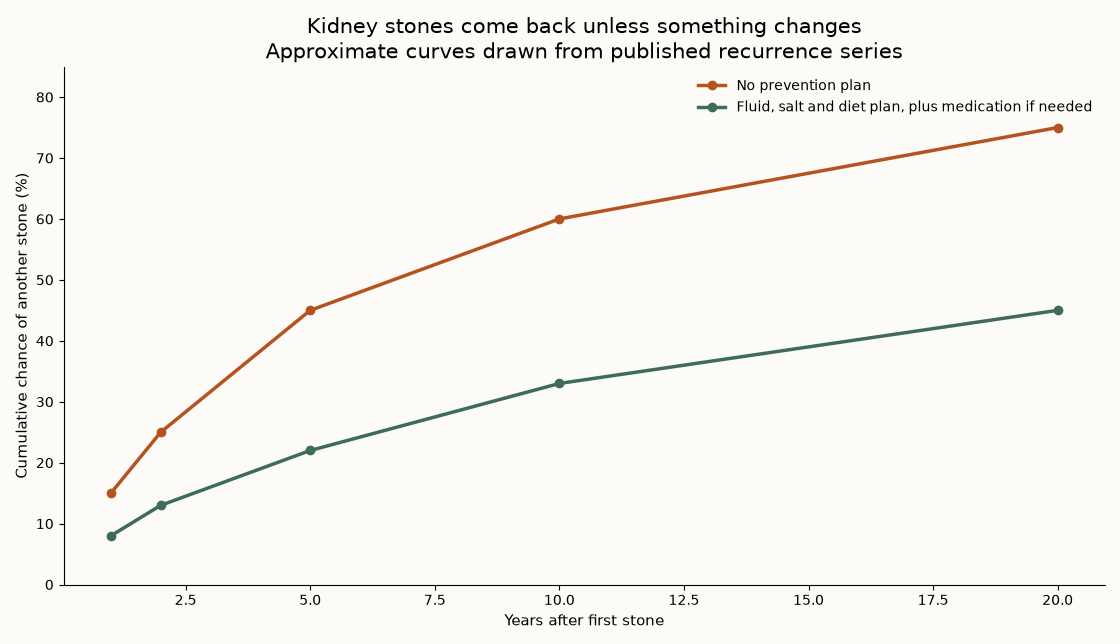
The recurrence numbers are the ones that should change your behaviour. Without any preventive plan, somewhere around half of first time stone formers have another stone within five to ten years, and the cumulative risk keeps rising after that. With a proper plan built around fluid, salt, diet and, where needed, medication, that curve flattens substantially.
First, find out what your stone was made of
This is the single most skipped step, and it changes everything downstream. Prevention advice for a calcium oxalate stone is not the same as for a uric acid stone, and it is completely different for an infection stone. If you pass a stone, catch it. Urinary strainers are cheap, and every emergency department has them. Send it for analysis.
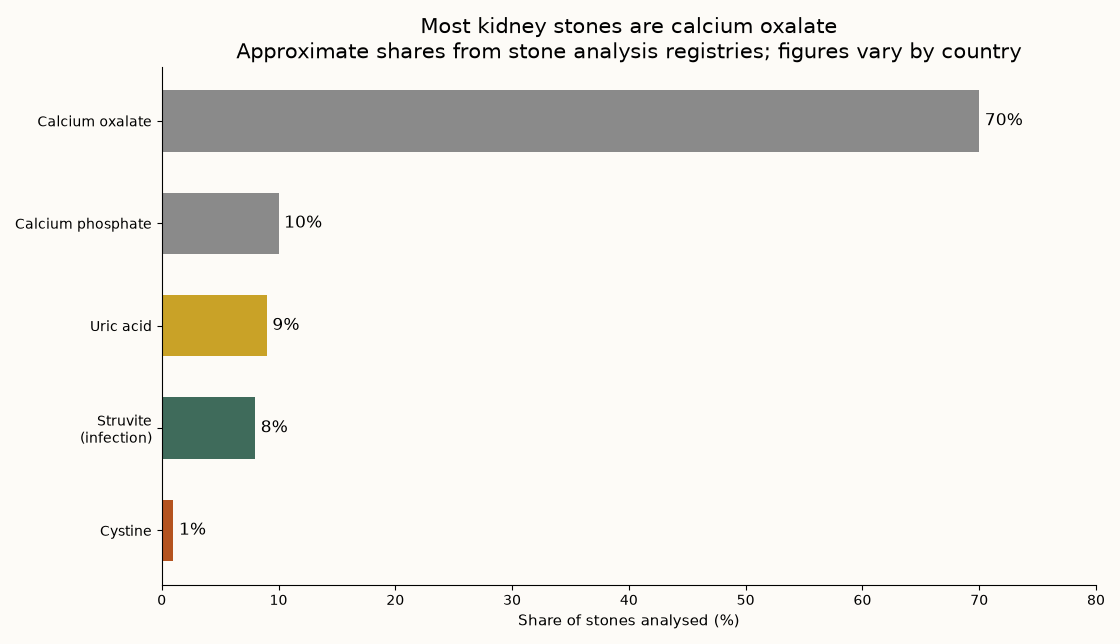
- Calcium oxalate. The majority. Driven by low urine volume, high urinary calcium, high oxalate, low citrate and high salt.
- Calcium phosphate. More common in women and linked to alkaline urine, sometimes to renal tubular acidosis or to topiramate.
- Uric acid. Forms in persistently acidic urine, strongly associated with obesity, insulin resistance, type 2 diabetes and high purine intake. These are the stones that can sometimes be dissolved medically rather than removed.
- Struvite. Grows from urinary infection with urease producing bacteria. Needs urological treatment, not diet.
- Cystine. Rare, inherited, usually starts young, needs specialist care.
If you have had two or more stones, a stone in childhood, a single kidney, chronic kidney disease or a family history, ask for a metabolic workup: a 24 hour urine collection measuring volume, calcium, oxalate, citrate, uric acid, sodium and pH, plus blood calcium and parathyroid hormone. Both the NICE guideline NG118 and American Urological Association guidance support this approach for recurrent stone formers.
Fluid: the intervention with the best evidence
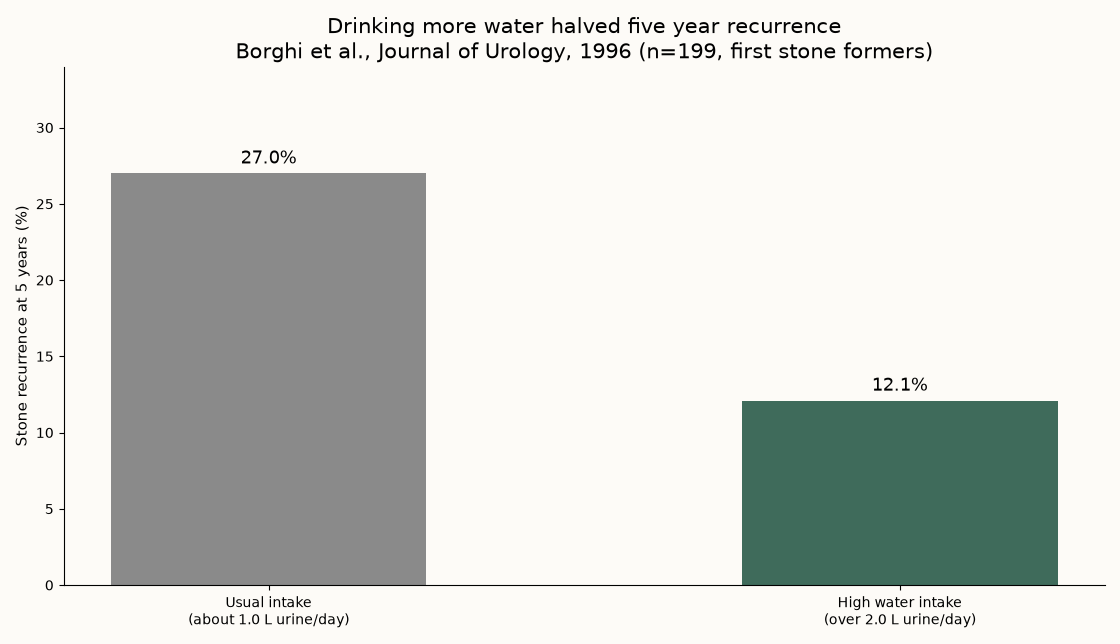
In a randomised trial of 199 people after a first calcium stone, the group told to drink enough to produce more than two litres of urine a day had a five year recurrence rate of 12 per cent, against 27 per cent in the control group. Their stones also took longer to appear (Borghi et al., Journal of Urology, 1996). That is a randomised result for tap water, which is remarkable when you consider what a drug with those numbers would cost.
The practical target is output, not input. Most adults need somewhere between 2.5 and 3 litres of total fluid a day to produce 2 to 2.5 litres of urine, and more if you work outdoors, train hard or live somewhere hot. The honest test is colour: pale straw all day, including the first one in the morning if you drank something before bed.
What I actually changed, after two episodes of pretending I would just remember to drink more:
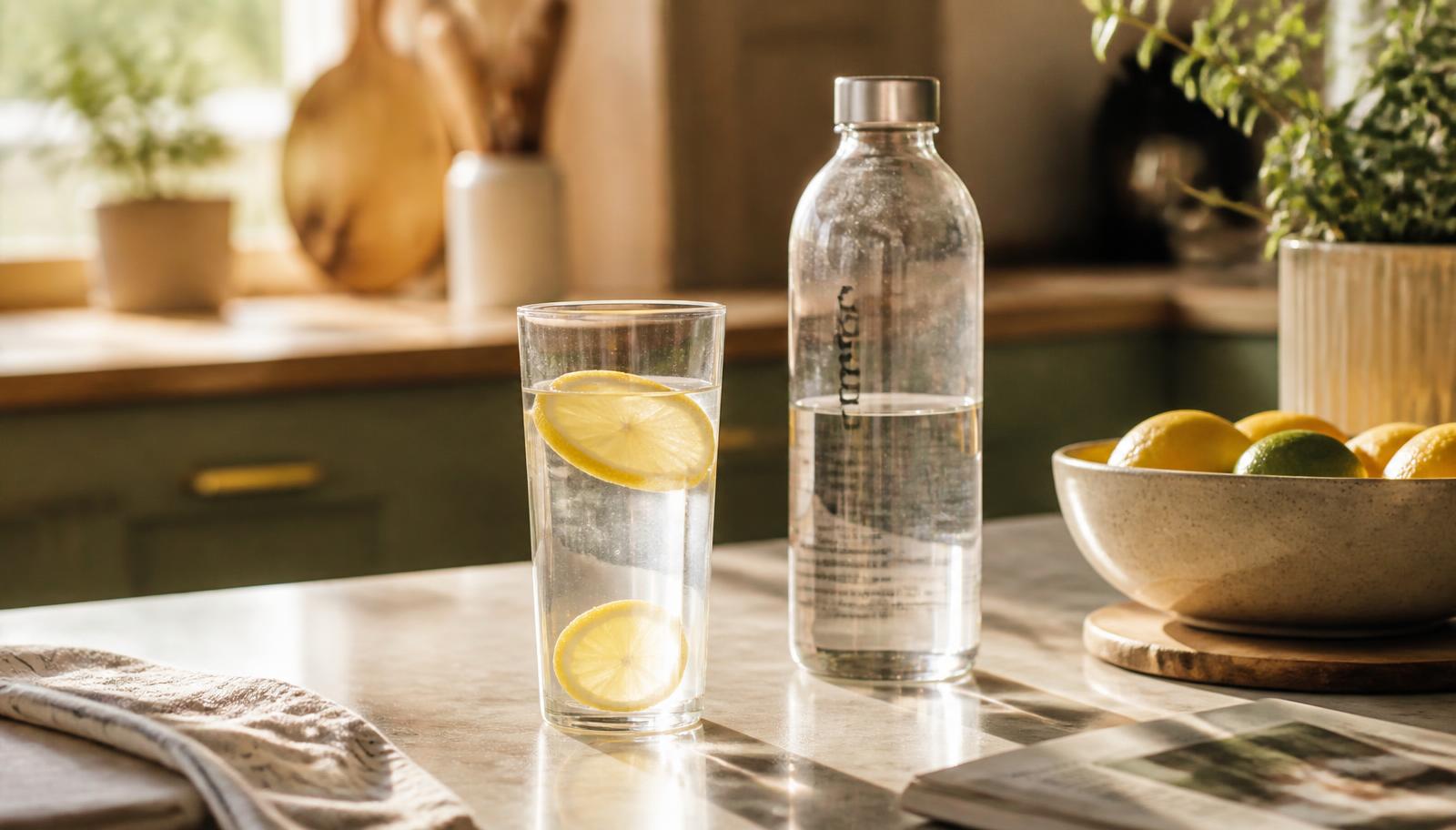
- A one litre bottle on the desk, filled twice, done by six in the evening.
- A glass of water beside the bed, drunk when I wake in the night, because urine is most concentrated overnight and that is when crystals have the easiest time.
- Extra fluid logged deliberately on gym days and on any day above 25C.
- Citrus in the water. Lemon and lime raise urinary citrate, which binds calcium and keeps it in solution. It is not a cure, but it is free.
Not all fluids behave the same way. Sugar sweetened drinks, and particularly those sweetened with fructose, are associated with higher stone risk, while coffee, tea, beer and orange juice are associated with lower risk in large cohort studies (Ferraro et al., Clinical Journal of the American Society of Nephrology, 2013). That surprises people about coffee. The caffeine diuresis appears to be outweighed by the extra volume.
The calcium mistake that made things worse for a generation
For years, people with calcium stones were told to cut dietary calcium. It sounds logical and it is wrong. In a five year randomised trial of 120 men with recurrent calcium oxalate stones, a diet with normal calcium but restricted salt and animal protein produced a recurrence rate of 20 per cent, against 38 per cent on the traditional low calcium diet (Borghi et al., New England Journal of Medicine, 2002). Large cohort data pointed the same way nearly a decade earlier (Curhan et al., New England Journal of Medicine, 1993).
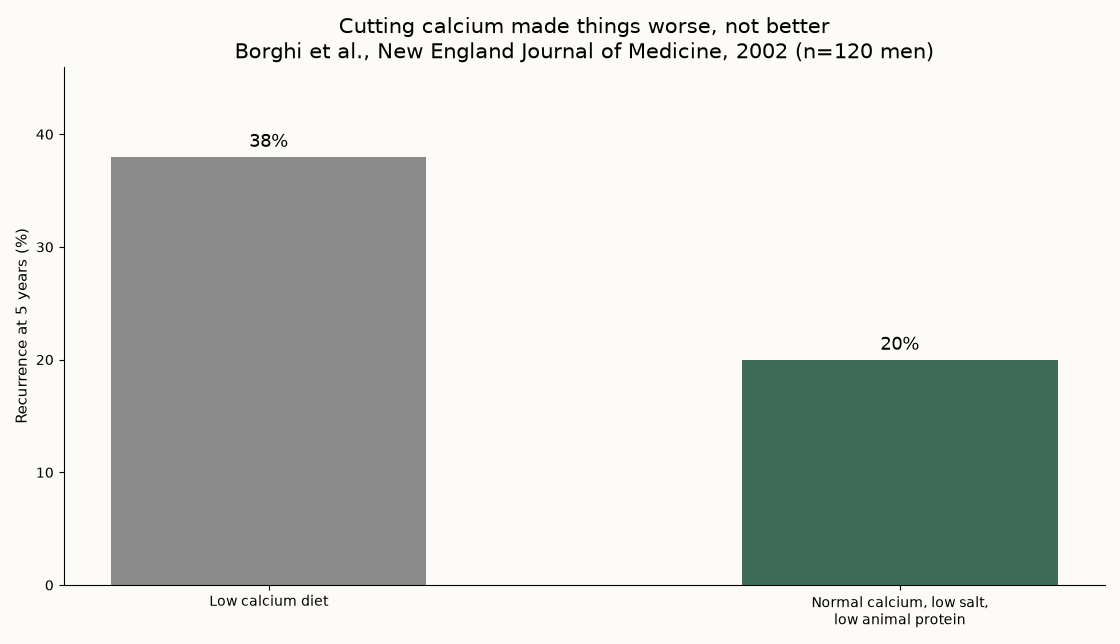
The mechanism is simple once you see it. Calcium eaten with food binds oxalate in the gut and the pair leaves in your stool. Take the calcium away and free oxalate is absorbed instead, arriving in the urine where you least want it. The rule that follows is about timing as much as amount: eat your calcium with the meal that contains the oxalate. Yoghurt with the spinach, milk with the tea, cheese with the beetroot salad.
Calcium supplements taken between meals are a different matter and have been linked to higher risk. If you need them for bone health, take them with food.
Salt, protein and sugar
Sodium drags calcium into the urine. Every extra gram of salt raises urinary calcium, so a high salt diet quietly manufactures the raw material for stones even when your blood calcium is perfectly normal. Aim for under 6 g of salt a day in UK terms, or under about 2,300 mg of sodium. Most of it is not in your salt shaker. It is in bread, sauces, processed meat, stock cubes and takeaway food.
Animal protein, particularly red meat and shellfish, raises uric acid and acid load while lowering urinary citrate. You do not have to stop eating meat. Moving from a large portion at two meals a day to a moderate portion at one changes the urine chemistry measurably.
Dietary patterns matter more than single nutrients. People eating a DASH style diet, high in fruit, vegetables, low fat dairy and whole grains and low in salt and processed meat, had substantially lower stone risk across three large cohorts (Taylor et al., Journal of the American Society of Nephrology, 2009).
Body weight, insulin resistance and the uric acid link
Higher body weight, larger waist size and weight gain in adulthood are all associated with increased stone risk, and the association is stronger in women (Taylor et al., JAMA, 2005). Insulin resistance impairs the kidney's ability to excrete ammonium, which leaves urine more acidic, which is exactly the condition in which uric acid stones form. This is why stone clinics and diabetes clinics see so many of the same people.
If you want a starting point for where your own weight sits, our BMI calculator includes the lower threshold of 23 that the NHS recommends for adults of South Asian, Chinese, other Asian, Middle Eastern, Black African and African Caribbean background, alongside the standard cut off of 25. The same lower threshold logic applies here, because the metabolic risk that drives uric acid stones appears earlier in these groups too.
One caution worth stating plainly: very low carbohydrate and high protein weight loss diets, and rapid weight loss after bariatric surgery of the malabsorptive type, both increase stone risk. Losing weight is good for you. Losing it through a diet that acidifies your urine and floods it with oxalate is not.
When diet is not enough: the medication conversation
If you keep forming stones despite doing the fluid and diet work properly, ask about medication. Thiazide diuretics reduce urinary calcium and have been standard practice for decades, although the picture became more complicated when the NOSTONE trial, New England Journal of Medicine, 2023 found that hydrochlorothiazide did not reduce recurrence compared with placebo over roughly three years. That does not mean thiazides are useless for everyone, but it does mean the decision should be individual and based on your 24 hour urine results rather than automatic.
Potassium citrate raises urinary citrate and pH and is well established for low citrate calcium stones and for uric acid stones. Allopurinol helps when urinary uric acid is high. For uric acid stones specifically, alkalinising the urine can dissolve existing stones, which is the closest thing to a genuine cure in this field.
A twelve week plan you can actually follow
| Weeks | Focus | What that looks like |
|---|---|---|
| 1 to 2 | Fluid only | Two litre bottle, finished daily. Track urine colour. Change nothing else. |
| 3 to 4 | Salt | Read labels on bread, sauces and ready meals. Cook two extra meals a week at home. |
| 5 to 6 | Calcium timing | Include a dairy or fortified alternative at every meal containing high oxalate food. |
| 7 to 8 | Protein and sugar | One moderate meat portion a day. Drop sugar sweetened drinks entirely. |
| 9 to 10 | Movement and weight | Build to 150 minutes of walking or equivalent per week. |
| 11 to 12 | Measure | Repeat 24 hour urine collection and review the numbers with your clinician. |
What I would tell my thirty eight year old self
Take the stone in for analysis. Ask for the 24 hour urine test rather than waiting for a third episode. Understand that this is a chronic metabolic condition that happens to announce itself in an extremely dramatic way, and treat it like one. And put the bottle on the desk where you can see it, because the whole thing genuinely does hinge on something that boring.
Six years on, no further stones. I do not know whether that is the water, the salt, the weight or luck, and honestly I do not much care. The plan costs me nothing and the alternative is the bathroom floor.
Read next
- Kidney stone treatment: how to pass a stone and when you need surgery
- Kidney stone diet and exercise: what to eat, what to skip and how to move
Frequently asked questions
How much water should I drink to prevent kidney stones?
Enough to produce more than 2 litres of urine a day, which for most adults means 2.5 to 3 litres of fluid, and more in hot weather or with heavy exercise. Spread it across the day and include a drink before bed.
Should I avoid calcium if I have calcium stones?
No. Normal dietary calcium taken with meals lowers recurrence, because it binds oxalate in the gut. Restricting calcium raised recurrence in a randomised trial. Avoid supplements taken away from food.
Does lemon water really help?
Citrus raises urinary citrate, which inhibits calcium crystal formation. The effect from ordinary lemon water is modest compared with prescription potassium citrate, but it is harmless and it makes people drink more water, which is the bigger win.
Can being overweight cause kidney stones?
Higher weight and waist size are linked to higher risk, largely through insulin resistance making urine more acidic and increasing uric acid stone formation. Check where you sit with a BMI tool that uses the right ethnicity threshold for you.
This article is general information, not medical advice. Sudden severe flank pain with fever, vomiting you cannot control, or inability to pass urine needs urgent medical assessment.