The second one arrived at 3 a.m. I knew instantly what it was, which helped and did not help in equal measure. Knowing means you do not panic about dying. It also means you know exactly how long the next few hours are going to feel. I remember standing in the hallway in the dark doing the maths on whether to wake anyone, and deciding to give it twenty minutes. Twenty minutes later I was kneeling on the kitchen floor with my forehead on a cupboard door.
What I want to give you here is the thing I did not have that night: a clear map of what happens next. What the hospital will do, what the numbers really are for passing a stone on your own, which drugs help and which turned out not to, what the surgical options involve, and how to tell the difference between pain you can ride out at home and pain that needs an ambulance.
What kidney stone pain actually feels like
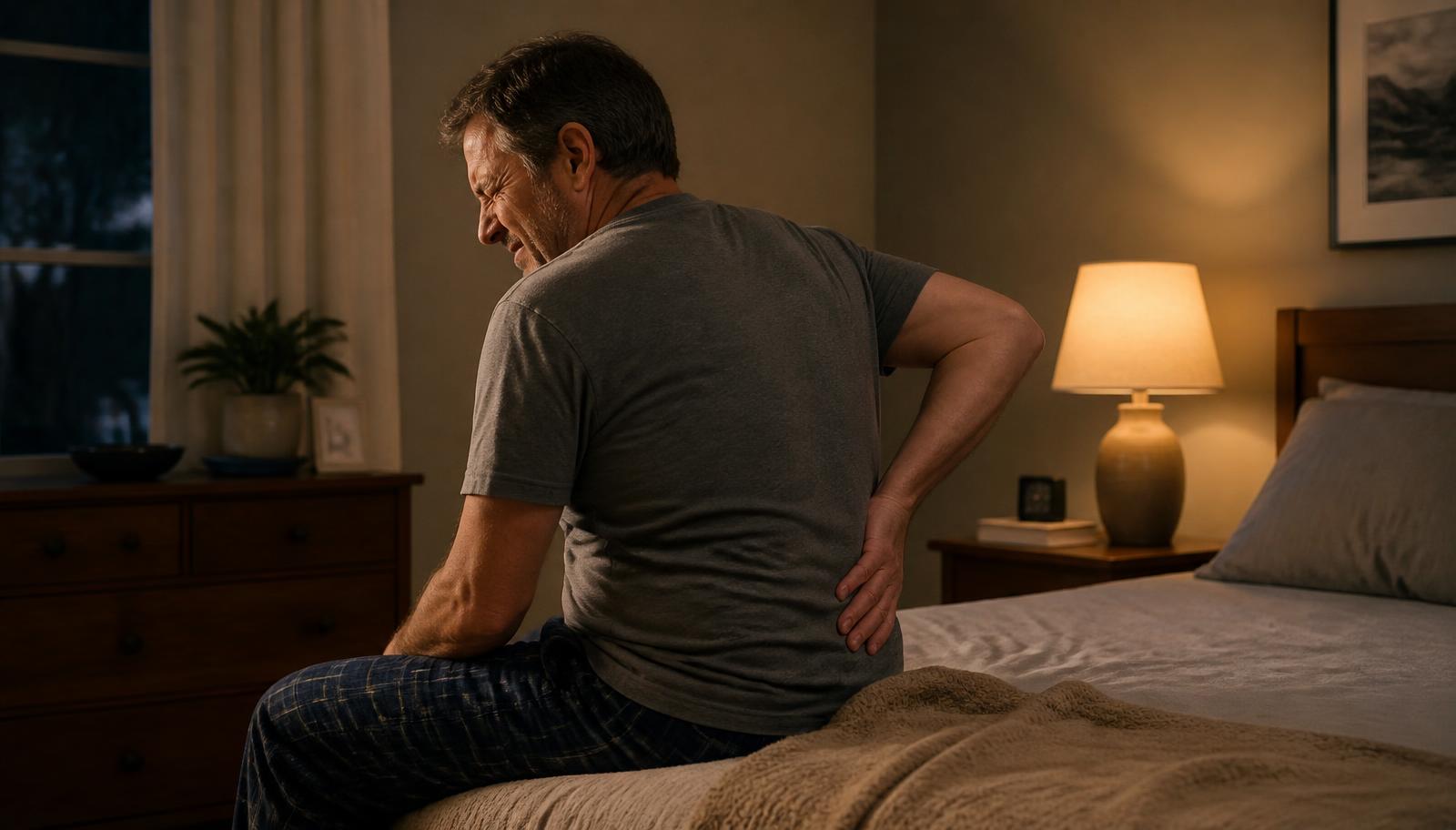
Renal colic is not a steady ache. It builds over minutes to something that takes your breath, holds, and then eases slightly before building again. It usually starts in the flank, between the lower ribs and the hip, and moves forward and down towards the groin as the stone travels. Nausea and vomiting are extremely common, because the nerve supply of the ureter and the gut overlap. Many people become restless rather than still, which is one of the ways clinicians distinguish it from an abdominal problem where movement makes things worse.
Go to hospital the same day, without waiting, if you have any of these:
- Fever or shaking chills with the pain. An obstructed, infected kidney is a surgical emergency and can become septic within hours.
- Vomiting that stops you keeping fluids or tablets down.
- Passing little or no urine, or you have only one working kidney.
- Pain that is not controlled by anything you have at home.
- Pregnancy, or known chronic kidney disease, or a transplanted kidney.
What the hospital will do
Expect three things: pain relief, a urine dip and bloods, and imaging. On pain relief, the evidence favours a non steroidal anti inflammatory such as diclofenac as first line rather than going straight to opioids, because NSAIDs reduce ureteric smooth muscle activity and renal blood flow as well as blocking pain, and they produce less vomiting. The NICE guideline NG118 recommends exactly this, with intravenous paracetamol as the second option and opioids only if the first two are unsuitable.
On imaging, low dose non contrast CT of the kidneys, ureters and bladder is the standard for adults, because it finds almost every stone and tells you its exact size and position. Ultrasound is used first in pregnancy and in children, and is often used in follow up to spare radiation.
Will it pass on its own? The numbers by size
This is the question everybody asks in the cubicle, and the honest answer is that size and position predict most of it. Stones in the lower ureter, closest to the bladder, do better than stones stuck up at the top.
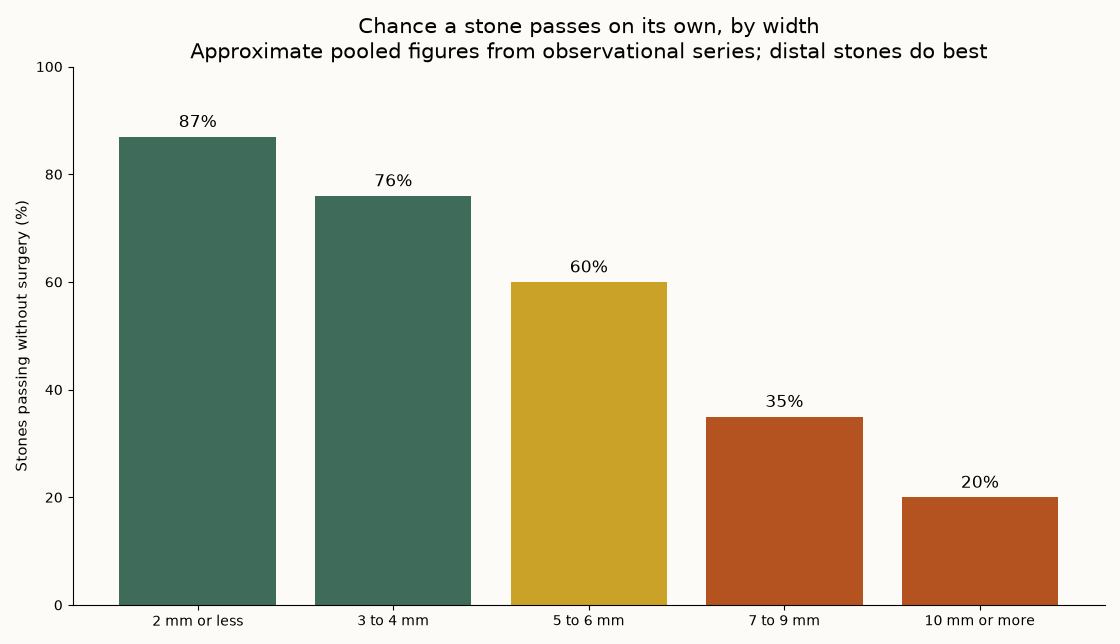
In broad terms, stones of 4 mm or less usually pass, typically within one to three weeks. Stones between 5 and 7 mm are a genuine coin toss and often need more time or intervention. Stones of 10 mm and above rarely pass and are usually treated actively. A reasonable observation period for a small stone is four to six weeks, provided pain is controlled, there is no infection and kidney function is stable. Beyond that, prolonged obstruction risks permanent damage to the kidney.
Medical expulsive therapy: the drug story that changed
For years, alpha blockers such as tamsulosin were given routinely to help stones pass, on the logic that relaxing ureteric smooth muscle widens the exit. Then the SUSPEND trial, published in The Lancet in 2015, randomised 1,167 people to tamsulosin, nifedipine or placebo and found no significant difference in the proportion needing intervention at four weeks.
That result reshaped practice, but it did not abolish the drug. Later analyses and meta analyses suggest the benefit is real but concentrated in larger distal stones, roughly 5 to 10 mm sitting low in the ureter. Current NICE advice reflects that narrower use. So if you are offered tamsulosin for a 7 mm stone near the bladder, that is evidence based. If you are offered it for a 3 mm stone, it is unlikely to be doing much, and the honest expectation is that the stone was going to pass anyway.
Getting through it at home
Assuming you have been assessed, the stone is small and you have been sent home to wait, these are the things that made the difference for me and that match what stone clinics advise.
- Take the anti inflammatory on a schedule, not on demand. Chasing the pain after it starts is a losing game. Regular dosing for the first few days, as prescribed, keeps you ahead of it.
- Heat helps more than people expect. A heat pad or a hot bath relaxes the surrounding muscle spasm. It will not move the stone, but it makes the waves survivable.
- Keep drinking normally. Flooding yourself with litres of water during an obstruction does not flush the stone out and can increase pressure and pain. Drink to thirst and keep your urine pale. Save the aggressive fluid target for prevention afterwards.
- Keep moving gently. Walking is fine and probably helpful. Sitting still for days is not.
- Strain your urine. Every time, into the same container if you have to. Catching the stone gives you its composition, and composition dictates the whole prevention plan.
Anecdote is not evidence, but the moment the stone passes is unmistakable. Mine felt like a switch. One second the pressure was there and the next it simply was not, and I sat on the edge of the bath laughing in a slightly unhinged way at four in the afternoon.
The surgical options, in plain language
| Procedure | Best suited to | What it involves | Typical recovery |
|---|---|---|---|
| Shock wave lithotripsy (ESWL) | Kidney and upper ureteric stones under about 10 mm | Focused sound waves from outside the body break the stone into fragments you then pass | Usually same day, some blood in urine and colic as fragments move |
| Ureteroscopy with laser | Ureteric stones, harder stones, failed lithotripsy, larger stones | A fine telescope passed up through the bladder, stone fragmented with a laser and removed | Day case, often a temporary stent for days to weeks |
| Percutaneous nephrolithotomy (PCNL) | Large kidney stones over about 20 mm, staghorn stones | Keyhole access through the back directly into the kidney | One to three nights in hospital, one to two weeks off work |
| Emergency drainage (stent or nephrostomy) | Obstruction with infection | Relieves pressure first, stone treated later once the infection is cleared | Urgent, then a planned second procedure |
A word about stents, because nobody prepares you. A ureteric stent keeps the tube open while things settle, and it works, but a substantial number of people find it uncomfortable: urinary frequency, urgency, blood in the urine and a dragging flank ache when they pass urine. It is temporary. Ask how long it is staying and who is booking the removal before you leave the ward.
Is there a cure, or only management?
For uric acid stones there is something close to a genuine cure. Because they form in acidic urine, raising urine pH with potassium citrate can dissolve existing stones without any procedure at all, which is why the composition analysis matters so much. For calcium stones, dissolution is not possible and treatment means removing what is there and then preventing the next one.
That prevention work is not optional garnish. Recurrence without a plan is the default. The evidence on fluid volume, salt, dietary calcium timing and weight is covered in detail in our guide to preventing kidney stones, and the food and training side is in the kidney stone diet and exercise guide.
One factor sits behind a lot of uric acid stone formation: insulin resistance and excess body weight, which make urine persistently acidic. If that is part of your picture, our BMI calculator will show you where you sit, including the lower 23 threshold the NHS applies to people of South Asian, Chinese, other Asian, Middle Eastern, Black African and African Caribbean background.
Things that do not work, however confidently they are sold
- Apple cider vinegar. No clinical trial evidence for dissolving stones. It will not hurt you in small amounts, but it is not treatment.
- Beer to flush it out. The extra fluid does something. The alcohol dehydrates and the volume needed is not compatible with a working liver.
- The olive oil and lemon juice protocol. Popular online, no evidence, and it makes the vomiting worse.
- Very high dose vitamin C. Above about 1,000 mg a day it is metabolised to oxalate and has been linked in cohort data to higher stone risk in men.
- Roller coaster riding. There genuinely is a small study on this. It is charming and it is not a treatment plan.
Frequently asked questions
How long does it take to pass a kidney stone?
Small stones of 4 mm or less usually pass within one to three weeks. Larger stones take longer or do not pass at all. Most teams will not observe an obstructing stone for more than four to six weeks because of the risk to kidney function.
What is the fastest way to relieve kidney stone pain at home?
A prescribed non steroidal anti inflammatory taken on a regular schedule, plus heat on the flank. If pain is not controlled or you have fever or vomiting, this is a hospital problem rather than a home one.
Does tamsulosin help pass a stone?
The large SUSPEND trial found no overall benefit, but later evidence suggests a modest benefit for distal ureteric stones of roughly 5 to 10 mm. It is not useful for small stones.
Can kidney stones cause permanent damage?
Yes, if a stone obstructs a kidney for a prolonged period, and urgently if infection is present behind the obstruction. This is why fever with stone pain is treated as an emergency.
This article is general information, not medical advice. Severe flank pain with fever, uncontrolled vomiting or reduced urine output needs urgent medical assessment.