The first time someone told me type 2 diabetes could go away, I assumed they were selling something. A colleague, forty four, two years on metformin, came back from a summer with a different face and a printout he kept in his wallet. HbA1c 39. Off medication. He said it like a man who had won a raffle he did not know he had entered.
He had not been cured. That word matters, and the difference between "cure" and "remission" is the whole subject of this article. But what happened to him is real, it is reproducible, and it has been measured in properly designed trials rather than in testimonials.
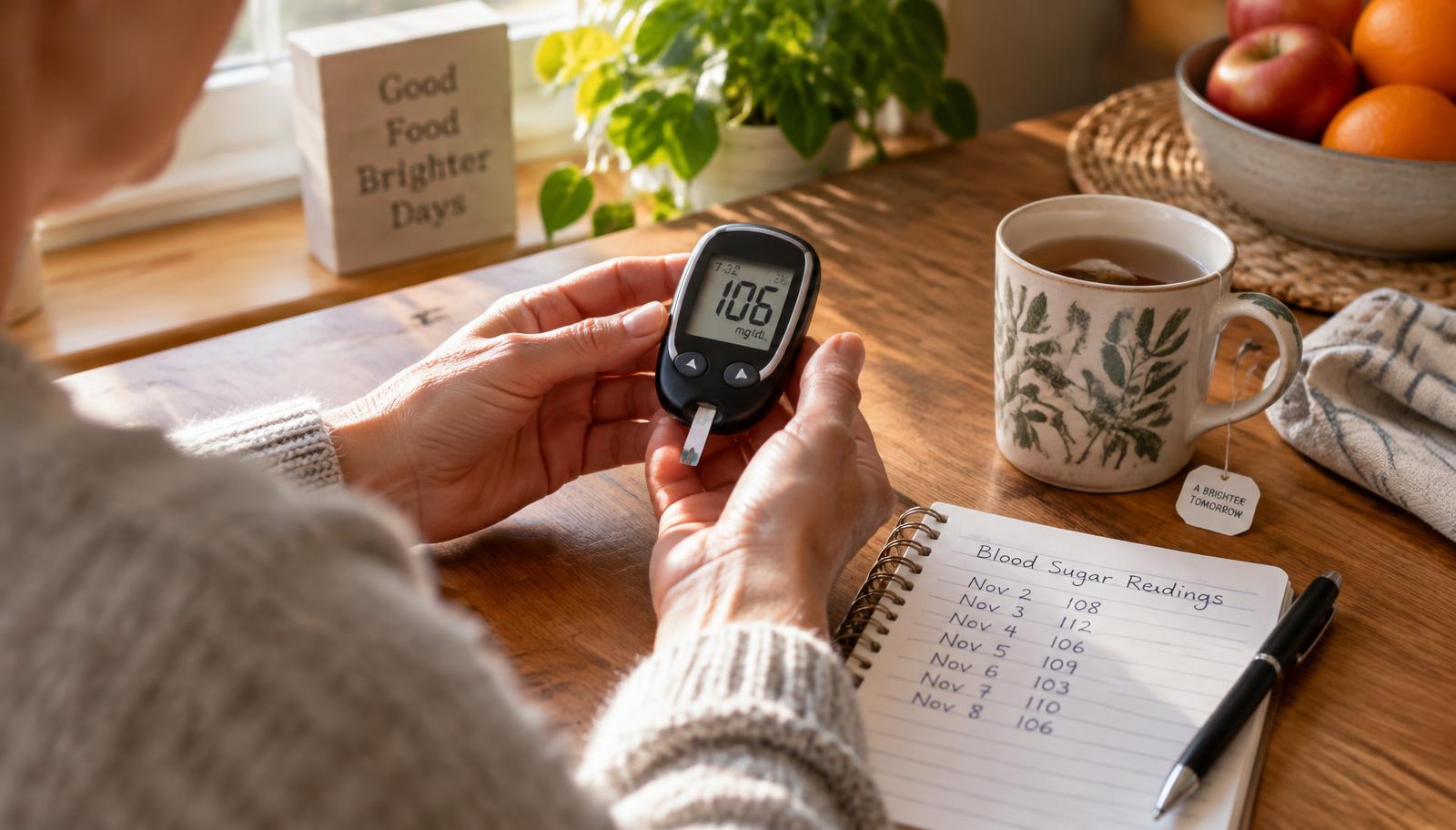
Cure versus remission: the honest answer
There is no cure for type 2 diabetes. There is remission, which an international expert consensus defines as an HbA1c below 48 mmol/mol (6.5 per cent) sustained for at least three months after stopping glucose lowering medication. The underlying susceptibility stays with you. If the weight comes back, so usually does the diabetes.
That sounds like a downgrade. It is not. Remission means normal blood sugar, no tablets, and a lower risk of the complications that make diabetes frightening: eye disease, kidney disease, nerve damage and heart attacks. If you offered most people with type 2 diabetes that trade, they would take it in a heartbeat.
What the DiRECT trial actually showed
DiRECT is the study that changed clinical thinking. Researchers in Scotland and Tyneside randomised people with type 2 diabetes of up to six years' duration, in ordinary GP practices, to either usual care or a structured weight management programme: a total diet replacement of about 825 to 853 kcal a day for three to five months, then careful food reintroduction and long term support.
At twelve months, 46 per cent of the intervention group were in remission, compared with 4 per cent of the control group (Lean et al., The Lancet, 2018). The number that really matters is how remission tracked with weight lost.
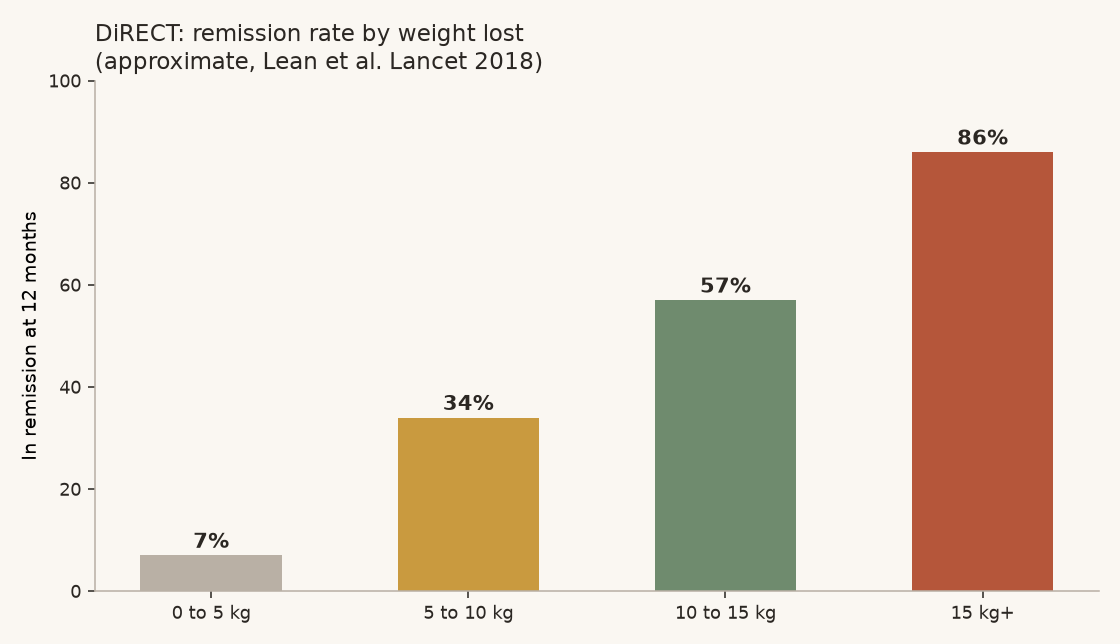
At two years, 36 per cent were still in remission, and the people who kept the weight off kept the result. Follow up work has shown remission can persist for years when weight is maintained. This is not a trick and it is not a fad. It is a dose response relationship between fat loss and pancreatic function.
The twin cycle: why losing fat works
Roy Taylor's twin cycle hypothesis explains the mechanism in a way you can actually picture. Excess calories over years lead to fat accumulating in the liver. A fatty liver pushes out more glucose and exports fat to the pancreas. Fat inside the pancreas suppresses the beta cells that release insulin quickly when you eat. Blood sugar rises, which drives more fat storage, and the loop tightens.
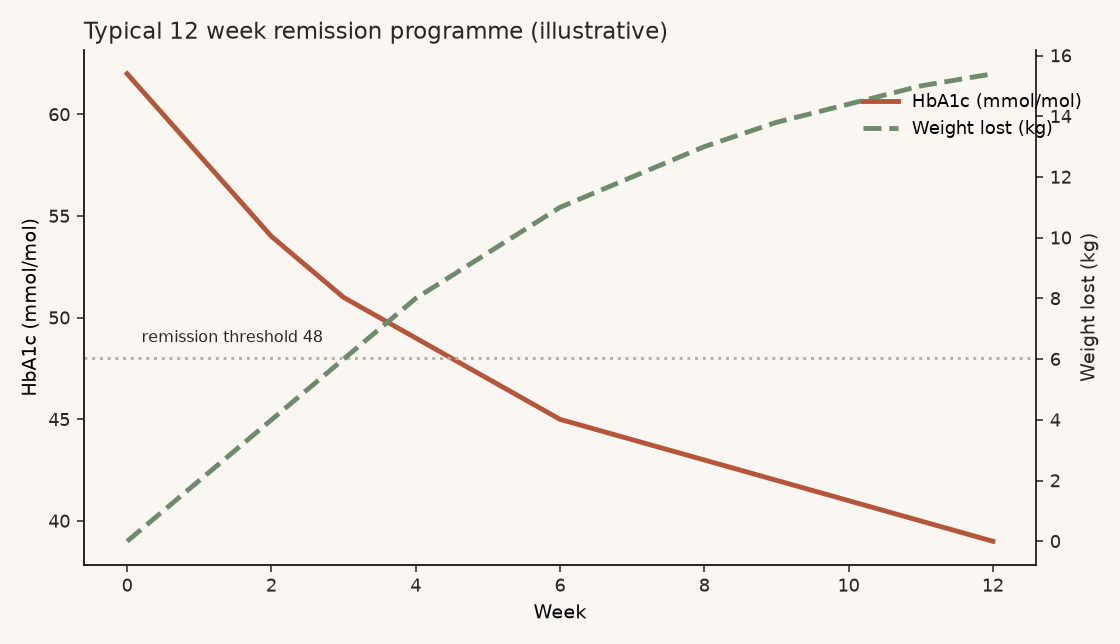
Remove the liver fat and the liver behaves again within about a week. Remove the pancreatic fat and beta cell function can recover over roughly eight weeks, provided the cells are dedifferentiated rather than dead. That recovery window is why duration matters so much: the shorter the time since diagnosis, the better the odds.
Who has the best chance
| Factor | Better odds | Harder |
|---|---|---|
| Time since diagnosis | Under 6 years | Over 10 years |
| Medication | Diet alone or metformin | Insulin, multiple agents |
| Weight above personal threshold | 10 kg or more to lose | Already lean at diagnosis |
| Beta cell reserve | Good C peptide | Low C peptide |
Lean people with type 2 diabetes can still achieve remission, but they usually need to lose proportionally less weight and they hit their personal fat threshold sooner. This is also where ethnicity becomes important: South Asian adults frequently develop type 2 diabetes at a BMI that would be called healthy on the standard chart. Check your number against the right threshold using our BMI calculator with the NHS 23 setting before you decide you have nothing to lose.
The three routes to remission
1. Total diet replacement, medically supervised
Around 800 to 900 kcal a day of formula shakes and soups for eight to twelve weeks, then structured food reintroduction. This is the DiRECT method and the basis of the NHS Type 2 Diabetes Path to Remission Programme. It must be supervised, because medication needs adjusting on day one. Anyone on insulin or sulfonylureas risks dangerous hypoglycaemia otherwise.
2. A sustained food based deficit
Slower, and the evidence base is weaker for remission specifically, but it works for plenty of people. Low carbohydrate and Mediterranean patterns both have trial support for lowering HbA1c. The critical variable is total weight lost and kept off, not the specific macronutrient story.
3. Metabolic surgery
Gastric bypass and sleeve gastrectomy produce the highest remission rates of anything we have, partly through weight loss and partly through gut hormone changes that begin before much weight is lost. It carries surgical risk and requires lifelong vitamin monitoring.
GLP-1 medicines such as semaglutide and tirzepatide complicate the definition, because blood sugar normalising while you take a glucose lowering drug is not remission by the formal definition. They are genuinely powerful tools for the weight loss step. What happens after stopping them is the open question.
What to expect if you try it
- Week one is the worst. Headaches, cold hands, irritability, constipation. It passes.
- Medication changes on day one. Non negotiable, and only with your clinician.
- Blood pressure tablets often need reducing too. Standing up too fast will tell you.
- Food reintroduction is where people relapse. Plan it before you start, not on the day.
- Weight maintenance is the whole game. Monthly weighing with a 2 kg action trigger is the simplest system that works.
If remission does not happen
Roughly half the DiRECT participants did not reach remission at one year, and many of them still improved their HbA1c, their blood pressure, their liver fat and their quality of life. A 10 mmol/mol drop in HbA1c is a real reduction in complication risk even if the label does not change. Please do not let a binary word delete a genuine result.
My colleague is four years out now. He weighs himself every Sunday, eats something close to a Mediterranean diet during the week, and walks after dinner because his wife makes him. He talks about it far less than he used to, which is probably the healthiest sign of all.
The medication question, handled honestly
People often assume that going into remission means their old medication was pointless. It was not. Metformin, SGLT2 inhibitors and GLP-1 agonists all protect organs while your blood sugar is high, and two of those classes have independent evidence for reducing heart and kidney events. Coming off them is a consequence of the weight loss, not the goal of it.
The practical sequence in most remission programmes looks like this. Sulfonylureas stop on day one, because they force insulin release regardless of what you eat and will cause hypoglycaemia on a low calorie diet. Insulin doses are cut sharply, sometimes by half, and monitored daily. SGLT2 inhibitors are usually stopped too, because of the risk of ketoacidosis when carbohydrate intake drops. Metformin is often the last to go. Blood pressure medication frequently needs reducing within two weeks, which is why dizziness on standing is such a common early report.
None of this is something to improvise. If your practice cannot supervise it, ask to be referred to one that can, or ask about the NHS Type 2 Diabetes Path to Remission Programme, which is free and designed around exactly this problem.
Monitoring after remission
Remission is not discharge. You keep your annual review, and you keep the parts of it that catch complications early: retinal screening, foot checks, kidney function and blood pressure. The reason is simple. Any damage that accumulated during the years of high glucose does not reverse just because the number has normalised, and the risk of relapse over five years is real.
| Check | How often after remission |
|---|---|
| HbA1c | Every 6 to 12 months, lifelong |
| Weight | Monthly at home, same day and conditions |
| Blood pressure | Annually, more often if previously treated |
| Eye screening | Continue as advised, usually annually |
| Foot check | Annually, plus self checks if you have any neuropathy |
The relapse trigger that works
Weight regain is gradual and invisible until it is not. The simplest system that holds up in maintenance research is a single action threshold: pick your post programme weight, add 2 kg, and treat crossing that line as an instruction rather than a feeling. Two weeks of tighter eating brings it back. Waiting for 8 kg does not.
Two other habits show up repeatedly among people who keep it off: they weigh themselves regularly rather than avoiding the scales, and they have a pre decided plan for holidays, illness and bereavement, which are the three events that end most maintenance attempts.
Sources
- Lean MEJ et al. Primary care led weight management for remission of type 2 diabetes (DiRECT). The Lancet 2018;391:541-551.
- Lean MEJ et al. Durability of a primary care led weight management intervention, two year results. DiRECT trial publications.
- Taylor R. Twin cycle hypothesis and pathogenesis of type 2 diabetes. Newcastle University.
- American Diabetes Association. Standards of Care in Diabetes 2025.
This article is general information and is not medical advice. Very low calorie diets and medication changes must be supervised by a clinician.