My dad was told he had prediabetes on a Tuesday afternoon in a room with a broken blind. The nurse said the word "borderline" and he heard "fine". He drove home, made the same dinner he always made, and did not think about it again for two years. By then it was not borderline any more.
I have thought about that appointment a lot. Not because anybody did anything wrong, but because the gap between "your blood sugar is creeping up" and "here is exactly what to do on Monday morning" is enormous, and almost nobody fills it in. So this is the article I wish someone had handed him. It is long, it cites its sources, and it assumes you are a busy adult with a normal life rather than a person with three spare hours a day.

The short version
Type 2 diabetes is largely preventable, and we know this from trials rather than from opinion. In the US Diabetes Prevention Program, a structured lifestyle programme cut the rate of progression from prediabetes to type 2 diabetes by 58 per cent over roughly three years, and did better than the drug metformin, which cut it by 31 per cent (Knowler et al., New England Journal of Medicine, 2002). The Finnish Diabetes Prevention Study found almost exactly the same number by a different route, which is the kind of agreement that makes researchers trust a result.
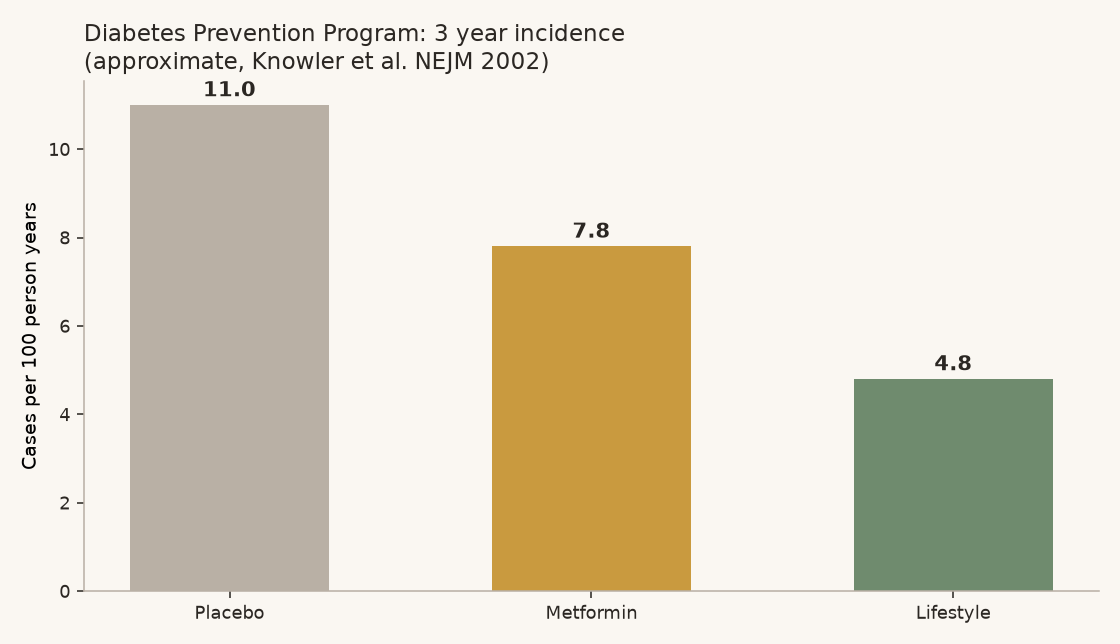
Four things did the heavy lifting in that programme, and none of them are exotic:
- Losing about 7 per cent of body weight, which for a 90 kg adult is roughly 6 kg.
- 150 minutes a week of moderate activity, mostly walking.
- Eating fewer refined carbohydrates and more fibre.
- Having someone check in, which is the part everybody skips.
Know your actual numbers first
Prevention without numbers is just vibes. Before you change anything, get three measurements written down somewhere you will see them again.
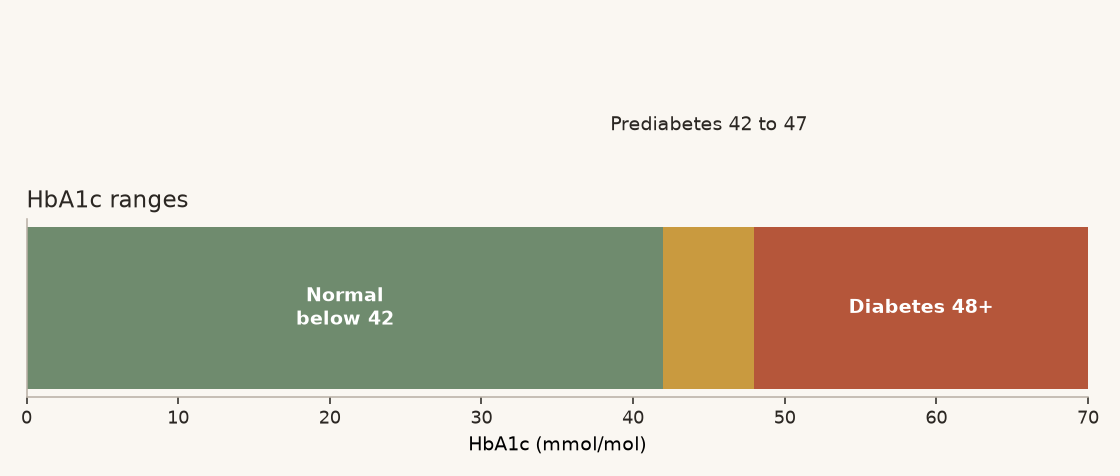
HbA1c. This is a blood test that reflects your average blood glucose over roughly three months. In the UK, 42 to 47 mmol/mol is prediabetes and 48 mmol/mol or above is the diabetes range. In US units that is 5.7 to 6.4 per cent and 6.5 per cent or above (American Diabetes Association, NHS).
BMI, adjusted for your background. This matters more than most people realise. The overweight threshold is a BMI of 25 for white European adults, but NHS and NICE guidance uses 23 for people of South Asian, Chinese, other Asian, Middle Eastern, Black African and African Caribbean background, because the same metabolic risk arrives at a lower body weight. Our BMI calculator has a toggle for exactly this, and it converts your healthy range back into kilograms and pounds so the number means something.
Waist measurement. Keep your waist under half your height. It catches visceral fat that BMI cannot see, and it works across ethnic groups. If you only ever measure one thing, measure this one.
Why 7 per cent weight loss does so much
Type 2 diabetes develops when fat accumulates where it does not belong, particularly in the liver and pancreas. Professor Roy Taylor's work at Newcastle showed that removing a relatively small amount of that fat can restore the first phase insulin response, which is the pancreas's quick burst of insulin when food arrives (Taylor, Newcastle University research). You do not need to become slim. You need to get below your own personal fat threshold, and for most people that is a handful of kilos.
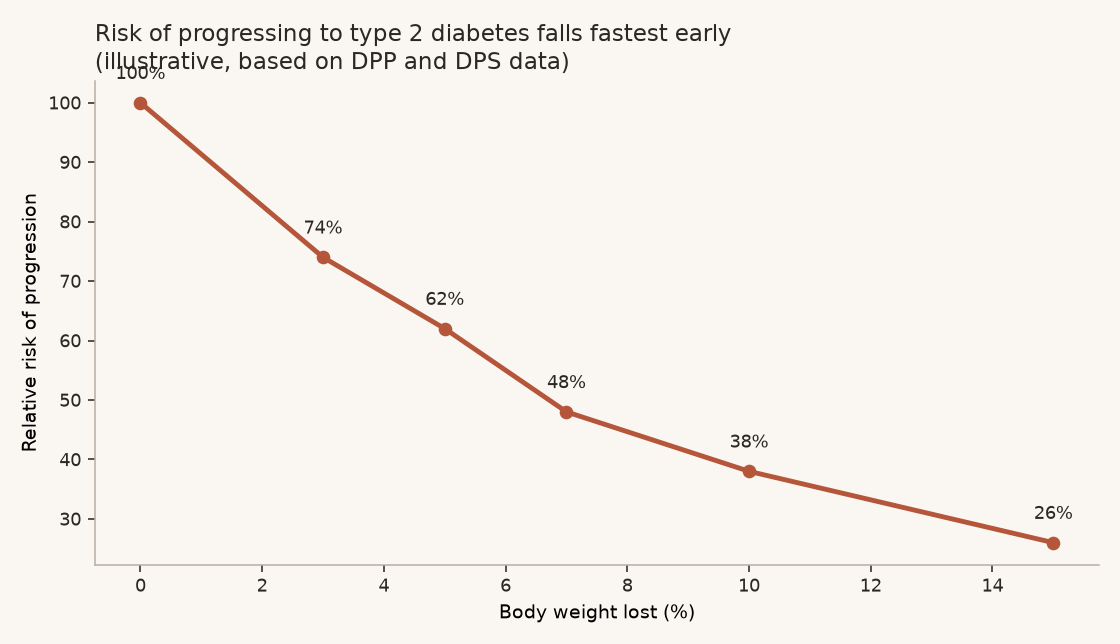
This is the part I find genuinely comforting. The first few kilos are worth more than the last few. If you have ever given up on a target of losing 20 kg, you were probably being asked for far more than your body actually needed.
The food changes that hold up under scrutiny
Nutrition arguments are exhausting, so here is what the higher quality evidence agrees on rather than what is trending.
Fibre is the single most underrated lever. A large series of meta analyses in The Lancet found that people eating 25 to 29 g of fibre a day had substantially lower rates of type 2 diabetes, heart disease and premature death, with benefits continuing above 30 g (Reynolds et al., The Lancet, 2019). Most adults eat around 18 g. Beans, lentils, oats, barley, whole fruit and vegetables with skins on close that gap without any special products.
Liquid sugar is worth removing before anything else. Sugary drinks are absorbed fast, do almost nothing for fullness, and are consistently linked with higher type 2 diabetes risk even after adjusting for weight.
A Mediterranean pattern beats a low fat pattern in trials. The PREDIMED trial found lower incidence of diabetes in people eating a Mediterranean diet with extra virgin olive oil or nuts, without any calorie restriction at all.
If you want the practical shopping list version of all this, read our companion guide on what to eat and what to limit with diabetes.
Movement: the bit that works faster than the scales
Exercise improves insulin sensitivity within hours, long before your weight changes. That mismatch is why so many people quit. They walk for three weeks, the scales barely move, and they conclude it is not working, when in fact their muscles are already handling glucose better.
Two evidence based habits give you the most return:
- Walk for two to five minutes after meals. A 2022 meta analysis in Sports Medicine found that short light walking bouts after eating meaningfully blunted the post meal glucose rise compared with sitting or even standing (Buffey et al., Sports Medicine, 2022).
- Lift something heavy twice a week. Muscle is where most glucose gets stored after a meal. More muscle means a bigger buffer.
Our full plan is here: the best exercises for diabetes and how to structure a week.
Sleep, stress and the things nobody puts on a poster
Short sleep raises insulin resistance measurably after only a few nights. Chronic stress raises cortisol, which raises glucose. Night shift work is an independent risk factor. None of this is a reason to feel guilty, and all of it is a reason to treat sleep as a health intervention rather than a luxury. If you are choosing between a 6 am gym session that costs you ninety minutes of sleep and an extra walk at lunchtime, take the walk.
A twelve week plan that does not require heroics
| Weeks | Focus | What success looks like |
|---|---|---|
| 1 to 2 | Measure, do not change | HbA1c, waist and BMI written down. One food diary week, honest. |
| 3 to 4 | Remove liquid sugar, add a post meal walk | Five walks a week after your largest meal. |
| 5 to 8 | Fibre to 30 g, protein at every meal | Beans or lentils four times a week. Two strength sessions weekly. |
| 9 to 12 | Hold and retest | Repeat HbA1c. Aim for 3 to 7 per cent body weight lost. |
What to ask your doctor or nurse
- What is my exact HbA1c number, not just the category?
- Am I eligible for a structured diabetes prevention programme? The NHS Diabetes Prevention Programme and similar US programmes are free in many areas.
- Should I be on metformin given my age and risk?
- Can we check cholesterol, blood pressure and liver enzymes at the same time?
Where my dad ended up
He did get a diagnosis in the end. He also got a nurse the second time who drew his numbers on the back of an envelope and asked him what he ate for breakfast, and something about being asked a specific question made it real. Porridge instead of toast. A walk to the corner shop instead of the car. He is fine. He is annoyingly smug about his HbA1c.
If you are somewhere on this road, please do not read this as a lecture. Prediabetes is not a moral failure, and type 2 diabetes is not a punishment for being greedy. It is a metabolic condition with strong genetic and environmental drivers, and it responds extremely well to a small number of boring habits repeated for a long time. Start with your BMI and your waist, then pick one habit. That is genuinely enough for week one.
Sources
- Knowler WC et al. Reduction in the incidence of type 2 diabetes with lifestyle intervention or metformin. NEJM 2002;346:393-403.
- Reynolds A et al. Carbohydrate quality and human health. The Lancet 2019;393:434-445.
- Buffey AJ et al. The acute effects of interrupting prolonged sitting time with standing and light walking. Sports Medicine 2022.
- American Diabetes Association. Diagnosis and HbA1c criteria.
- NHS. Type 2 diabetes overview.
This article is general information and is not medical advice. Do not start, stop or change any medication without speaking to your doctor.