My friend Priya was thirty three, a size ten, ran a half marathon the previous spring, and had a BMI of 24.6. On every chart she looked at, she was fine. She went to the doctor about persistent thrush and a tiredness she had been blaming on her toddler, and came out with an HbA1c of 51 and a diagnosis of type 2 diabetes.
She said the thing I have now heard from a dozen people: "but I'm not overweight." She was, for her body. The chart she had been reading was built for somebody else's.
The early signs, including the quiet ones
Type 2 diabetes is often described as symptomless, which is not quite true. It is symptom-vague. The signs are the kind you explain away.
- Passing urine more often, especially at night. Excess glucose pulls water with it.
- Thirst you cannot satisfy. A direct consequence of the above.
- Tiredness that sleep does not fix. Fuel in the blood is not reaching the cells.
- Cuts and grazes healing slowly.
- Recurrent thrush, urinary infections or boils. Sugar in urine feeds yeast and bacteria. This is often the first sign in women.
- Blurred vision that comes and goes. Glucose changes the shape of the lens.
- Tingling or numbness in the feet.
- Unexplained weight loss. More typical of type 1, but it happens.
- Dark velvety patches in the neck folds or armpits. Acanthosis nigricans, a visible marker of insulin resistance.
The NHS notes that many people live with type 2 diabetes for years before diagnosis, and that a substantial proportion already have some complication at the point of diagnosis (NHS, type 2 diabetes symptoms). That is the real argument for testing rather than waiting.
Who is most at risk
| Risk factor | Detail |
|---|---|
| Age | Risk rises from 40, or from 25 in South Asian, Black African and African Caribbean adults |
| Family history | A parent or sibling with type 2 diabetes roughly two to three times the risk |
| Ethnicity | South Asian, Black African, African Caribbean, Middle Eastern, Hispanic and Indigenous populations develop it earlier and at lower body weight |
| Waist | Over half your height, or over 94 cm for men and 80 cm for women, and over 90 cm for South Asian men |
| Gestational diabetes | Up to half of women affected develop type 2 diabetes within 10 years |
| PCOS | Insulin resistance is part of the condition itself |
| Blood pressure or lipids | Treated hypertension or low HDL with high triglycerides |
| Sleep and shift work | Sleep apnoea and night shifts are independent risks |
| Certain medicines | Long term steroids and some antipsychotics |
The BMI 23 rule, explained properly
BMI was derived from white European populations. At the same BMI, South Asian adults typically carry more visceral fat around the liver and pancreas and proportionally less skeletal muscle, and Black African and African Caribbean adults show an earlier rise in blood pressure and diabetes risk. NICE public health guidance PH46 therefore recommends treating a BMI of 23 as the overweight threshold and 27.5 as the obesity threshold for these groups, rather than 25 and 30.
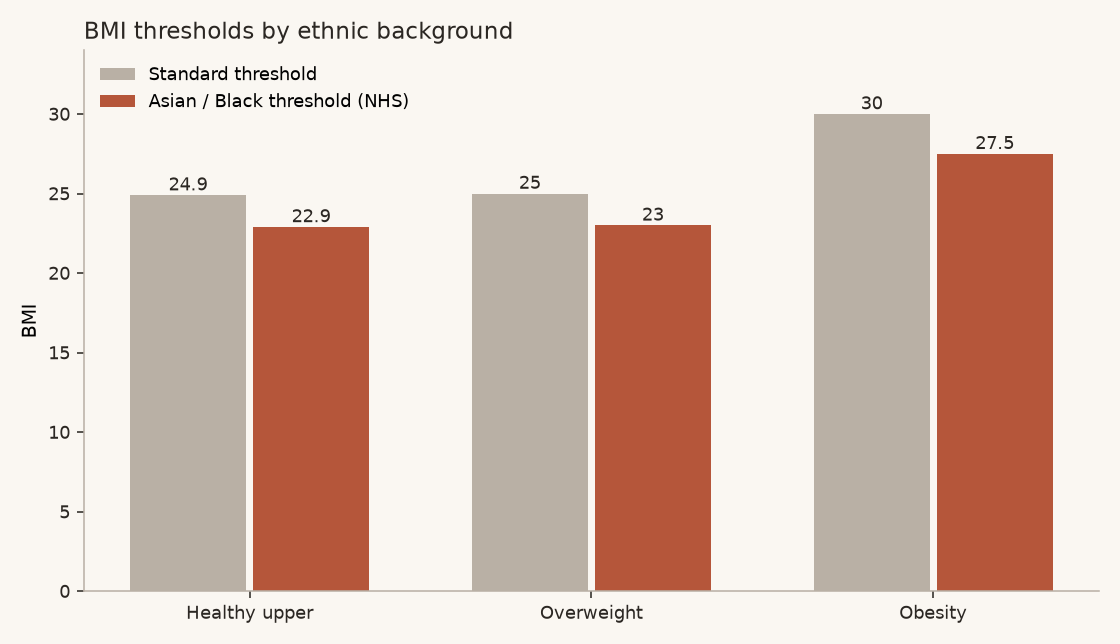
Priya's BMI of 24.6 was below 25 and above 23. On one chart she was healthy. On the correct one she had been in the overweight range for four years. This is not an abstract point. It changes who gets offered a blood test.
Work out where you sit using our BMI calculator with the Asian and Black threshold toggle. It shows both cut offs side by side and converts your healthy range into actual kilograms and pounds.
Getting tested, and what the numbers mean
| Test | Normal | Prediabetes | Diabetes |
|---|---|---|---|
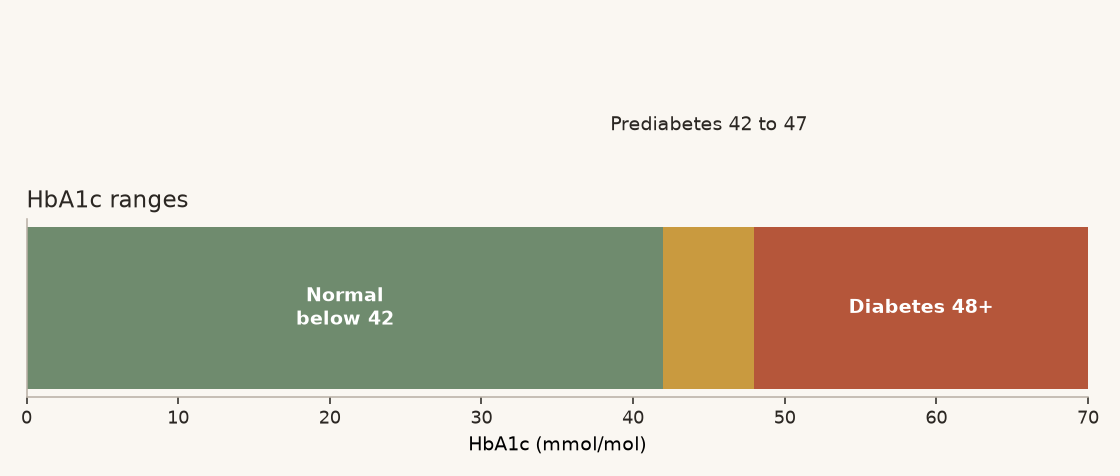
| HbA1c | Below 42 mmol/mol (5.7%) | 42 to 47 (5.7 to 6.4%) | 48 or above (6.5%+) |
| Fasting glucose | Below 5.6 mmol/L | 5.6 to 6.9 | 7.0 or above |
| 2 hour OGTT | Below 7.8 mmol/L | 7.8 to 11.0 | 11.1 or above |
Criteria per the ADA Standards of Care 2025 and NHS guidance. HbA1c can read falsely low in anaemia, pregnancy, recent blood loss and some haemoglobin variants, so if your symptoms and your number disagree, ask for a fasting glucose too.
Type 1, type 2, LADA and MODY
Adults diagnosed with type 2 who are slim, who deteriorate fast on tablets, or who have other autoimmune conditions are sometimes actually LADA, a slowly developing autoimmune diabetes. Strong family history across three generations with diagnosis under 25 can indicate MODY, which is genetic and often treated with a different medication entirely. Both are misdiagnosed routinely. If your story does not fit the standard type 2 picture, it is reasonable to ask about antibody testing and C peptide.
What to do in the next two weeks
- Measure your waist and your height. Write both down.
- Check your BMI against the correct threshold for your background.
- Book an HbA1c if you have any risk factor above, or any two symptoms.
- Ask for blood pressure, cholesterol and kidney function at the same appointment.
- If you land in the prediabetes band, read our prevention guide, which covers the trial evidence for turning it around.
- If you are already diagnosed, the remission guide explains what is realistically possible and for whom.
On being told you are the picture of health
Priya's anger, for about six months, was not really about diabetes. It was about having done everything she was told and still being missed, because the tool used to assess her was never designed with her body in mind. That anger was reasonable. She now has an HbA1c of 41, takes nothing, and tells everyone in her family to get tested at thirty rather than forty.
If you have ever been waved away because you did not look the part, please go and ask for the blood test anyway. It is a finger of blood and a two week wait, and it is the cheapest thing you will ever do for yourself.
Risk scores you can complete in three minutes
If you are unsure whether to ask for a blood test, a validated risk calculator is a reasonable first step. Diabetes UK and the NHS both host a Know Your Risk tool built on the QDiabetes and Leicester risk score work, which uses age, ethnicity, family history, waist, BMI and blood pressure history. In the US, the CDC and ADA host an equivalent short questionnaire. Neither diagnoses anything. Both are good at telling you whether a conversation with a clinician is worth booking.
One caveat worth knowing: these scores generally weight age heavily, which means they can under-call risk in younger South Asian and Black adults who are exactly the group most likely to be missed. If you are in your late twenties or thirties with a family history and a waist over half your height, a low score should not talk you out of a test.
Why early detection changes the outcome
The complications people fear from diabetes are largely a function of how long blood glucose stayed high and how high it went. Retinopathy, kidney disease and neuropathy develop over years. Detection at HbA1c 51 with no symptoms is a very different clinical situation from detection at 90 after two years of thirst.
There is also a window that closes. Remission rates are strongly related to duration since diagnosis, with the best results in people diagnosed within the last six years. A test taken this month can be the difference between a condition that can be pushed into remission and one that can only be managed. That is a strong argument for testing at the first suspicion rather than waiting for the annual review.
Gestational diabetes deserves its own paragraph
Women who have had gestational diabetes carry a substantially elevated lifetime risk of type 2 diabetes, and follow up is patchy almost everywhere. The postnatal glucose test at six to thirteen weeks is frequently missed in the chaos of a newborn, and the annual HbA1c that should follow is missed more often still. If this is you, put a recurring reminder in your phone now. It is the single most useful thing in this article for a large group of readers who currently get no follow up at all.
What a good appointment looks like
- You leave knowing your exact HbA1c number and what it means.
- Blood pressure, cholesterol, kidney function and liver enzymes were checked at the same time.
- Your ethnicity was taken into account when your BMI was interpreted.
- You were told about a structured prevention or remission programme if you qualify.
- You have a date for the repeat test rather than a vague "come back sometime".
If you did not get those things, it is entirely reasonable to ask for them. Bring the numbers you measured at home. Clinicians respond well to a patient who arrives with a waist measurement and a specific question.
Sources
- NHS. Type 2 diabetes symptoms.
- NICE. PH46: Type 2 diabetes prevention in people at high risk, including BMI thresholds by ethnicity.
- American Diabetes Association. Standards of Care in Diabetes 2025.
- Knowler WC et al. Diabetes Prevention Program, NEJM 2002.
- Diabetes UK. Types of diabetes.
This article is general information and is not medical advice. If you have symptoms, see a clinician rather than self diagnosing.